
Editor’s Note: This article was updated on Nov. 28, 2019, to reflect additional comments from the Canadian side of the IJC.
After the extensive flooding in 2017 and 2019 along the St. Lawrence River and Lake Ontario on both sides of the border, one of the targets of local ire has been the International Joint Commission’s Plan 2014.
But further action into investigating the actual impact of Plan 2014 is currently stalled and litigation is slowly winding its way through the courts.
The IJC is a collaboration between the U.S. and Canada that handles transboundary issues, including water level-related projects in the Great Lakes.
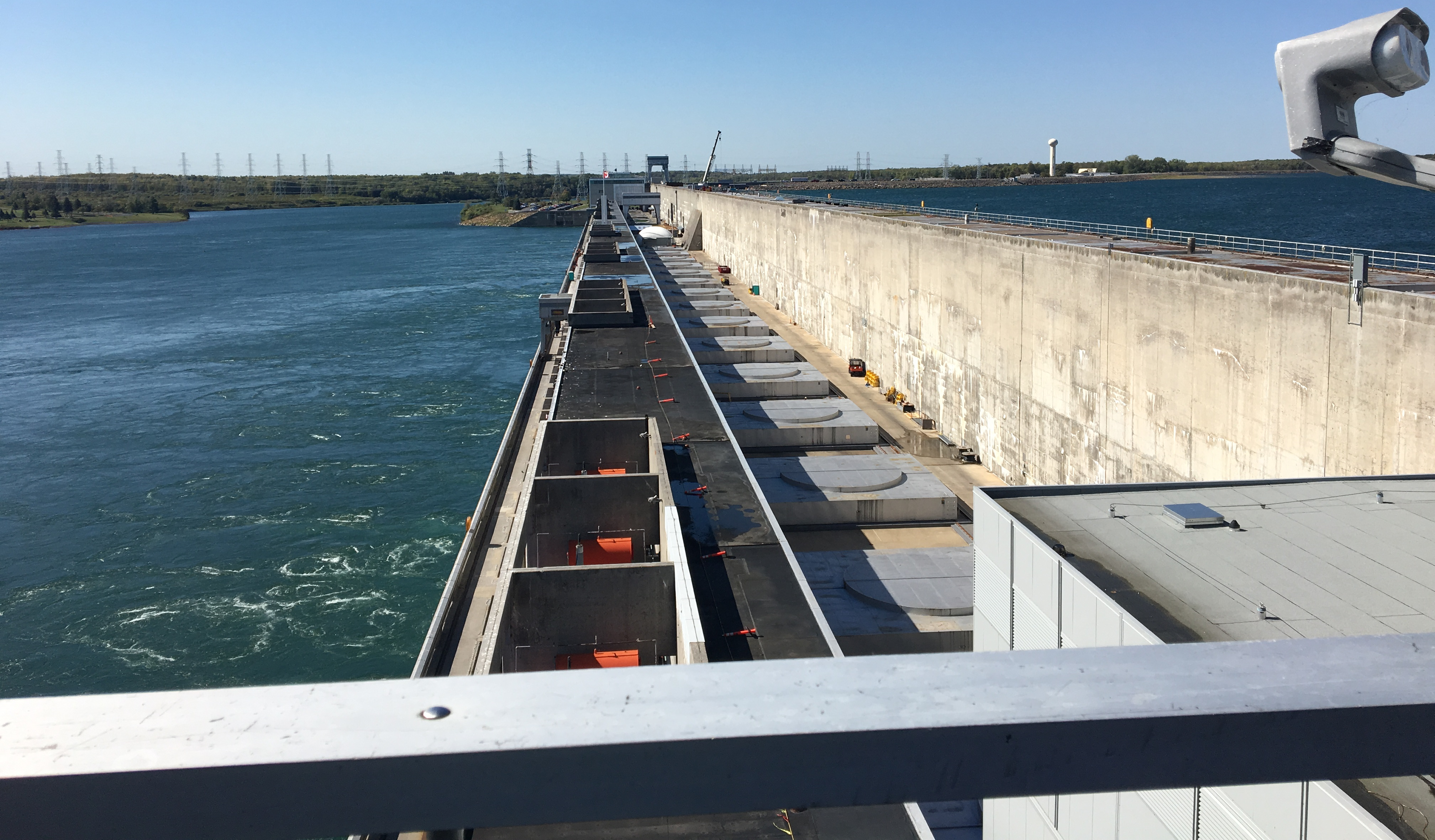
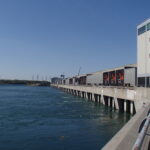
Plan 2014 is a regulation plan, implemented in 2017, and determines the flows through the massive binational Moses-Saunders Power Dam located on the St. Lawrence River between Cornwall, Ontario, and Massena, New York.
With many area residents pointing fingers at Plan 2014 for the 2017 and 2019 flooding issues, the IJC held meetings to discuss Plan 2014 and the possibility of doing an expedited review of it, according to Frank Bevacqua, the IJC’s U.S. public information officer.
The initial approval of Plan 2014 called for a review of it 15 years from its implementation.
And an expedited review is on hold while it waits for funding.
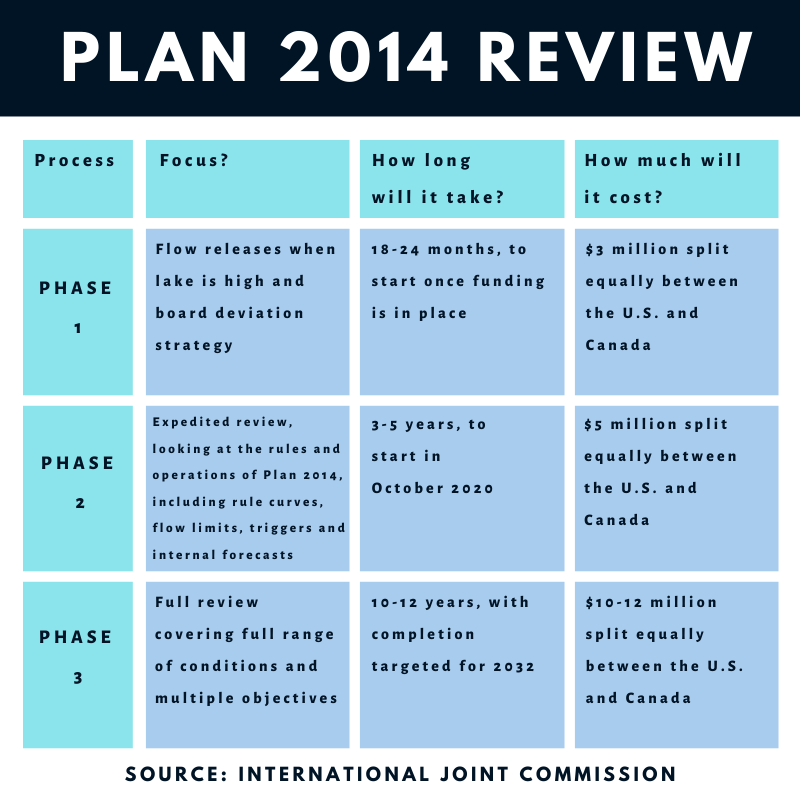
“The Great Lakes-St. Lawrence River Adaptive Management Committee has scoped that out thoroughly,” Bevacqua said. “We have not received any dedicated funding for that.”
All of the IJC’s funds for the U.S. side of things are appropriated by Congress.
“The money is in place on the Canadian side, pending funding of the U.S. section,” said Sarah Lobrichon, public affairs advisor for the Canadian half of the IJC. The funds will only be available if the U.S. matches the funds and “will expire in April 2021 regardless of U.S. funding.”
The IJC’s draft three-phase strategy for the expedited review has not been finalized or formally endorsed by the IJC boards or commissioners yet, Lobrichon said in an email. The Great Lakes-St. Lawrence River Adaptive Management Committee will discuss it at their December meeting, she added.
The IJC did allocate $150,000 of internal funds for four projects that contribute to the first phase, but the three phases won’t happen until funding for them comes in, Bevacqua said.
The four projects are an economic assessment of temporarily halting commercial navigation in the St. Lawrence Seaway, documenting high-water impacts of Lake Ontario’s south shore municipalities, assessing critical low-water thresholds for Lake St. Lawrence during winter operations and periods of ice cover, and assessing critical ice conditions for Lake St. Lawrence during low-water periods associated with winter operations.
“We’re very concerned about the outlook for next year,” Bevacqua said.
The IJC and the Army Corps forecasts for Lake Ontario water levels both show the possibility of water levels in 2020 being as high as or even slightly higher than this year’s.
“There’s a lot of uncertainty about the factors that will affect the levels, namely precipitation, temperature and those sorts of things, so the further out you go there’s more uncertainty,” Bevacqua said.
Turning to the courts
The IJC also is potentially dealing with Plan 2014 in the courts, as the New York State Department of Environmental Conservation filed a lawsuit against the organization over Plan 2014.
Department Public Information Officer Kevin Frazier declined an interview with Great Lakes Now.
“DEC does not comment on matters of pending litigation,” he said in an email.
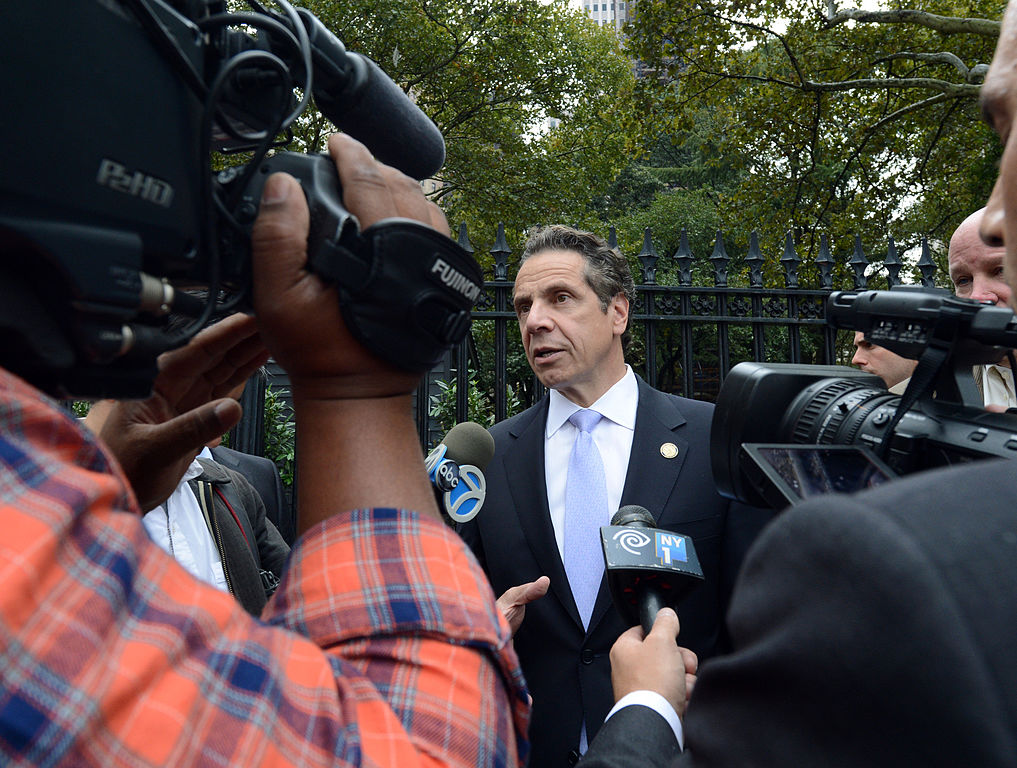
New York’s Gov. Andrew Cuomo announced on Oct. 9 that the New York DEC would be filing the suit.
“The lawsuit is a hard case – I will tell you that,” he said. “This is an international entity and it is going to be a difficult case for us to make, but it is our last resort… And it is unfair that we should be shouldered with over $1 billion in costs when the IJC has done absolutely nothing to reduce the damage to the state of New York.”
In an Oct. 24 interview with WXXI Radio, Cuomo gave a breakdown of the $1 billion figure, listing $100 million in emergency relief from the state, $300 million to rebuild the Lake Ontario shoreline, $120 in rebuilding efforts after 2017’s floods, and the rest under costs paid on the county, local and homeowner level.
At an announcement for $60 million for the St. Lawrence and Jefferson counties to help with Lake Ontario shoreline resilience, Cuomo mentioned the lawsuit, saying it “is just our way of saying, pay attention to New York.”
“The lawsuit has teeth because the IJC is not shielded from negligence. But also, we want to make a point,” Cuomo said in a North Country Public Radio interview on Nov. 1.
Cuomo also said in the interview that he’s not blaming the IJC for high water levels but for not balancing the water flows “fairly.”
“The IJC has not been served yet,” Bevacqua said. “We do have immunity from lawsuit under the International Organizations Immunities Act, but it’s not for the IJC to really decide on whether or not the IJC can be sued. It’s up to the court.”
Featured Image: Moses-Saunders Power Dam
More stories about regulating water levels
 Lawsuit: Great Lakes regulatory commission must pay NY flooding costs