
Butterfly populations are in decline across the continental U.S., dropping by 22% between 2000 and 2020 according to a study published in the journal Science. Almost a third of the 342 species studied have seen their numbers fall by more than half. To help combat this, the John Ball Zoo in Grand Rapids, Michigan launched its Great Lakes Rare Butterfly Program in 2021 to protect the region’s most threatened species.
The program is focused on three endangered species: the Poweshiek skipperling, Mitchell’s satyr and, starting in 2025, the Karner Blue butterfly. The Poweshiek skipperling, federally endangered since 2014, once spanned much of the Midwest but is now primarily found in isolated pockets of Michigan and Manitoba, according to the U.S. Fish and Wildlife Service.
Dave Pavlik, a research assistant with Michigan State University’s Haddad Lab and program manager at John Ball Zoo, noted that when he joined the Poweshiek Skipperling International Partnership in 2020, the butterfly’s situation was dire.
“Populations were declining every single year and there was serious concern that this butterfly was going to go extinct,” Pavlik stated.

Similarly, the Mitchell’s satyr has been federally endangered since 1991, persisting in only a handful of prairie fen wetlands in Michigan and Indiana.
The Karner Blue butterfly, federally endangered since 1992, has vanished from many of its historical ranges, with its largest remaining populations in Michigan and Wisconsin.
The primary cause for these declines, according to Bill Flanagan, Conservation Manager at John Ball Zoo, is “the loss of prairie habitat.” He explained that Poweshiek Skipperlings are “a prairie specialist, and here in Michigan, they’re just hanging on in a specialized kind of prairie called Prairie Fen that is globally pretty rare but pretty common in southern Michigan.”

Flanagan added, “We also are pretty convinced that some of the pesticides that are really commonly used right now, especially in the last 20 years, have had a role in their decline.”
To counteract these losses, the John Ball Zoo actively breeds and rears these endangered species in a controlled environment, with the goal of releasing some of them back into their native habitats annually. This process is time-sensitive, given the butterflies’ brief adult lives.

“These guys are only butterflies for about three to five days out of the year,” Flanagan explained. “We have about a two to a three-week period of time where everything that has to happen for this species almost all of it happens all at the same time.”
During this short window, the team focuses on strategic breeding.
“We’ll pair up males and females from lineages that are not related to keep that genetic diversity high,” Pavlik detailed. Females then lay eggs, which are collected daily and incubated before hatching on plants.

“We’ll collect those eggs every single day. They go into our incubator and then right before they hatch we get those eggs back on plants,” Pavlik explained. He says this kind of rearing ensures a boost in population numbers without further stressing fragile wild populations. It also establishes an “insurance population for the Poweshiek Skipperling here in case they do go extinct in the wild,” Pavlik added.
Releasing the butterflies requires consistent field work.
“Almost daily we’ll send somebody into the field with a case full of butterflies to be released back out into the wild,” Pavlik said , describing the two-hour drive to various release sites. Each released butterfly receives a unique wing marking, allowing the team to monitor its impact.

“That’s how we can track population trends and that’s how we can see if these releases that we’re doing are actually paying off,” Pavlik noted.
Population increases in the wild, tracked by partners like Michigan Natural Features Inventory, serve as key indicators of success.

“One of the main… issues that we’re having right now is that we’re quickly running out of space,” Pavlik revealed. Having rapidly expanded from one to three species, the program now requires significant space for the large numbers of butterflies needed for release. As a result, Pavlik said, the zoo is seeking alternative campuses to accommodate its growth.
The rarity of the butterflies also complicates efforts to maintain genetic diversity, especially when populations are critically low.
“Poweshiek Skipperling in 2022 the populations were so low that we were worried that they might be lost forever,” Pavlik stated. “So keeping the genetic diversity high in this program is a big priority for us”.
The amount of labor involved has also led to a rapid increase in staff and volunteers.
“The first year I think it was just myself and one technician managing the whole thing,” Pavlik recalled. “And now we’ve got a ton of people both at the zoo, we’ve got volunteers and we’re increasing staff every single year”.
The program’s success heavily relies on collaboration.
“Fish and Wildlife Service has been a huge supporter of this program from day one,” Pavlik emphasized , noting the critical role of “Great Lakes Restoration Initiative funding to get this program to where it is now.”

Key partners include Michigan State University’s Haddad Lab, the U.S. Fish and Wildlife Service, the Minnesota Zoo, and Michigan Nature Features Inventory. This network extends beyond U.S. borders to the Assiniboine Park Zoo in Winnipeg, Canada, too.
“If these species are going to persist people have to care about them,” Flanagan urged, encouraging the public to “just go out in your backyard, your local park, wherever you have access to plants and flowers and butterflies. Start to see what’s out there and really appreciate it.”
While the rare butterfly program is not open to the public for viewing, John Ball Zoo incorporates education on these endangered species through info sessions at the zoo and its education outreach program, Habitat Hero. Flanagan says that 22 different classrooms around the Grand Rapids area are getting lessons on butterflies, and some lessons are tied to the rare butterfly program.
The John Ball Zoo’s Great Lakes Rare Butterfly Program aims to actively restore a vital part of the Great Lakes’ natural biodiversity. Flanagan and Pavlick both emphasized that their work isn’t just about saving individual insects, it’s about demonstrating how targeted conservation can lead to recovery and developing techniques that could work for other endangered butterfly species, too.
Catch more news at Great Lakes Now:
How Barn Sanctuary champions compassion and conservation in the Great Lakes
A record year for Great Lakes piping plovers
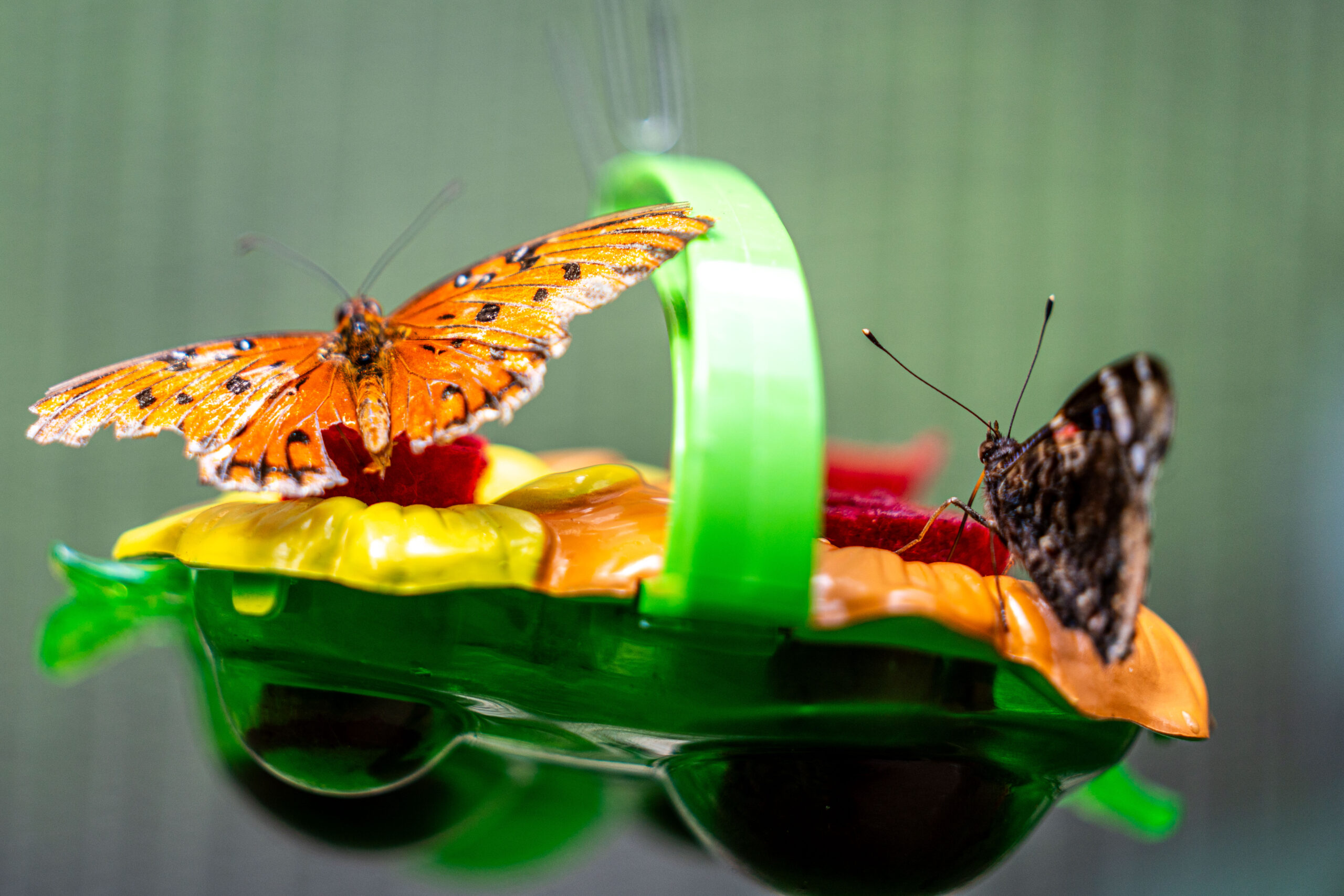
Featured image: Two butterflies rest on a hanging fixture together inside the butterfly enclosure at John Ball Zoo in Grand Rapids, MI on June 27, 2025. (Photo Credit: Donté Smith/Great Lakes Now)