
Great Lakes Moment is a monthly column written by Great Lakes Now Contributor John Hartig. Publishing the author’s views and assertions does not represent endorsement by Great Lakes Now or Detroit PBS.
As the Detroit Riverfront Conservancy moves forward following an embezzlement crisis, its 2024 visitor survey found that 99.4% of respondents would visit the Detroit Riverwalk again, and 99.3% would recommend it to others.
Pushing forward, it will also open the Ralph C. Wilson, Jr. Centennial Park and a new section of Riverwalk in front of Riverfront Towers in October of this year. In total, the tremendous revitalization of the Detroit riverfront has resulted in nearly $2 billion in economic benefits during the Conservancy’s first 20 years.
Detroit River revival
Detroit has long been recognized as an industrial town, and its namesake river was perceived as just a working waterway that supported industry and commerce. Like many North American cities, the Motor City made the riverfront its back door, with businesses facing inland and away from the water. Compounding the problem, Detroit became indifferent to the water pollution that was perceived as just part of the cost of doing business. By the 1960s, the Detroit River was one of the most polluted rivers in North America.
Today, the cleanup and recovery of the Detroit River represent one of the most remarkable ecological recovery stories in North America, in part because of the waterway’s severe pollution before environmental laws were enacted. Today, this river revival includes the return of bald eagles, peregrine falcons, ospreys, lake sturgeon, lake whitefish, mayflies, beavers and river otters.
Concurrent with the cleanup of the river and its ecological revival, businesses, community leaders and citizens started calling for improved public access to the river. It started in the late 1970s and gained momentum in the 1980s and 1990s. Indeed, more and more people began to see the potential of the Detroit River waterfront as a quality-of-life asset that could provide many social, economic and environmental benefits.
Detroit’s new waterfront porch
In the early 2000s, the City of Detroit created a blue-ribbon committee to re-envision the riverfront. Its vision was to create a new waterfront gathering place for Detroiters, their families, friends and visitors — a place where people want to live, work and play. In response, the Detroit Riverfront Conservancy was established in 2003 to transform Detroit’s international riverfront – the face of the city — into a beautiful, exciting, safe and accessible world-class gathering place for all, known as the Detroit Riverwalk.
One way of thinking about the Riverwalk is as a new community waterfront porch. Front porches on American homes have experienced a rise, a fall and another rise. In the mid-1800s, front porches on homes became a mainstay. These attractive and functional porticos provided shade and air circulation on hot, humid days. They also encouraged socializing.
But starting in the 1930s, American cities began experiencing a slow decline of porches on newly built homes. First, the Federal Housing Administration, established in 1934, created the financial mortgage system that required stricter house-building guidelines. This led to many developers favoring streamlined designs.
At the same time, increased car traffic brought noise and air pollution, making front yards and porches less desirable spaces for socializing and relaxation. As car culture expanded and urban sprawl grew, suburban developments shifted toward backyard-centric designs. Family time, once spent on front porches, now moved behind the house. Also contributing to the decline of porches was the widespread introduction of air-conditioning and television.
Then, in the 1980s, a planning and design movement called “New Urbanism” became popular. It focuses on creating walkable, mixed-use neighborhoods that offer a variety of housing options and convenient access to amenities. It aims to counteract suburban sprawl and promote more sustainable, vibrant and community-focused urban environments.
As part of this “New Urbanism” movement, front porches started coming back into style. Their benefits include:
- Promoting walkability and healthier lifestyles.
- Serving as gathering places that strengthen relationships with neighbors.
- Contributing to safer neighborhoods.
- Fostering a sense of place — a characteristic held by people that makes a place special or unique, that nurtures a sense of authentic human attachment and belonging.
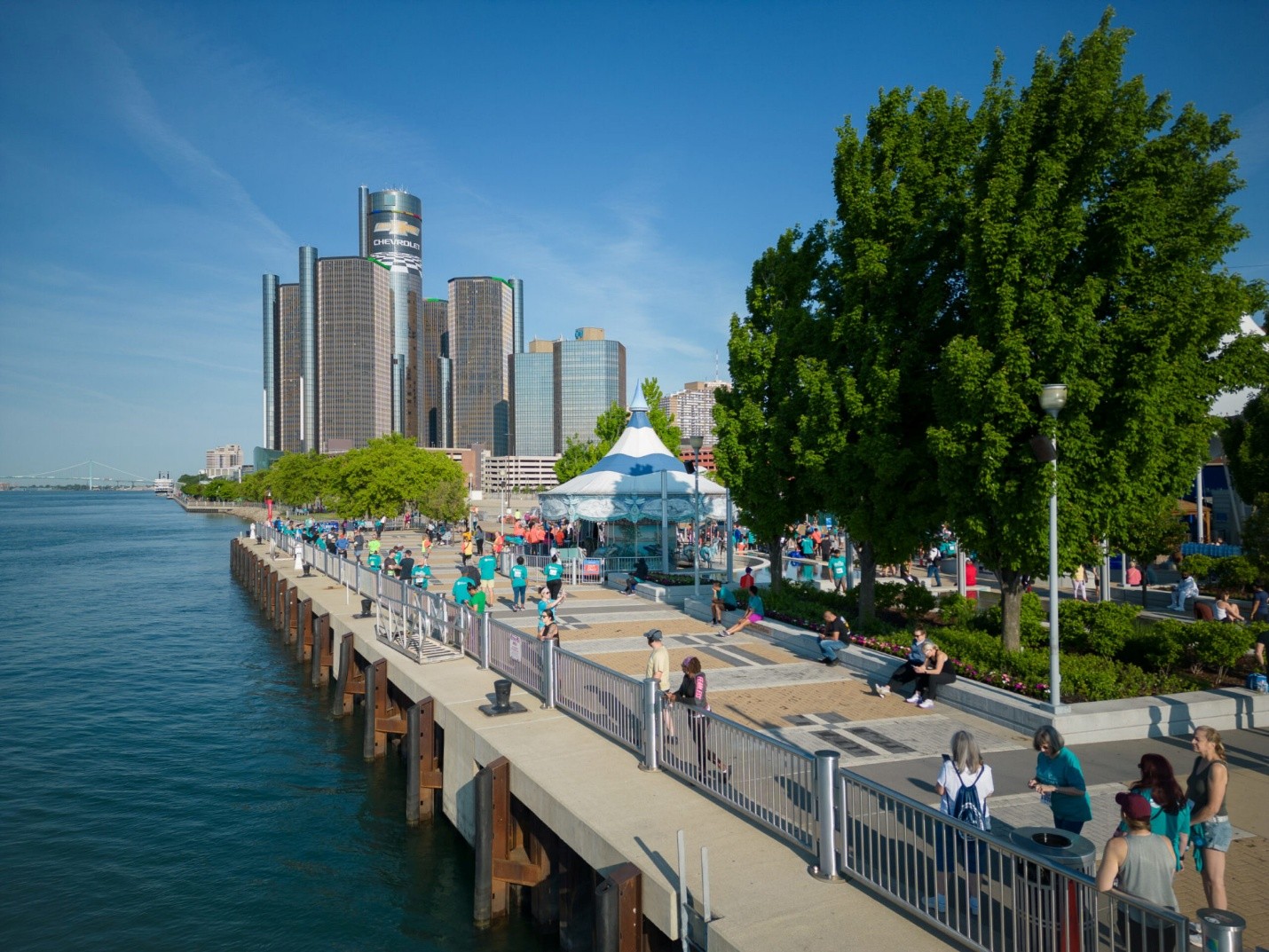
Today, the Detroit Riverwalk is like a new waterfront porch for both people and wildlife. It is beautiful, clean and safe. It is also free, open every day from 6 a.m. to 10 p.m. and welcoming to all. And it has become a major Michigan tourist attraction with more than three million annual visitors.
Indeed, the Detroit Riverwalk may be one of the most diverse places in Michigan, with visitors of all nationalities, races, cultures and income levels. On any given day, you can see families on bicycles, joggers, women wearing hijabs or businesspeople in suits, children playing and people relaxing on the riverfront and getting to know one another.

Economic impact of the Detroit Riverwalk
After its first ten years, the Conservancy built 3.5 miles of the nearly six-mile Riverwalk. In celebration of the completion of this first phase, it commissioned the firm CSL International to perform an economic impact study of the Riverwalk.
This study identified more than $1 billion in public and private sector investment during the first decade, and $639 million directly attributable to riverfront improvements. In addition, this study showed that nearly 3 million annual visitors were already using this public waterfront gathering spot. Finally, the study concluded that 90% of these visits would not have taken place without the significant riverfront improvements.
New research shows that there was $1.9 billion in total public and private sector investment (including the value of contributed land) since 2003, of which $939 million can be linked directly to the continued improvement of the riverfront.
In total, $470 million was spent on construction labor attributable to riverfront improvements. In total, 21,800 construction jobs were associated with all development projects along the riverfront since 2003, and these projects provided ongoing support for approximately 2,500 jobs annually.
Annual spending by visitors, residents, employees, and other operations along the riverfront was estimated at $82.3 million. Tax revenue generation by ongoing riverfront activity was estimated at $7 million annually.
Beyond quantitative economic impacts, riverfront improvements continue to change the perception of downtown Detroit. No longer is the waterfront dominated by industry, with little to no public access. It is now a place where people gather and make memories. And it is helping change the perception of Detroit being only an industrial town with a working waterfront to one with a new waterfront porch that is catalyzing community and economic revitalization.
Additionally, the Riverwalk has received substantial press coverage of riverfront developments, providing an estimated $1 million in positive exposure for Detroit.
“The Riverwalk has transformed a previously industrial area into a vibrant and attractive waterfront, significantly improving Detroit’s image and perception both locally and nationally,” said Ryan Sullivan, chief executive officer of the Detroit Riverfront Conservancy. “And it is boosting the local economy, fostering a sense of community pride and contributing to an improved quality of life for residents.”
If you haven’t been to Detroit’s riverfront, consider visiting the No. 1 Riverwalk in the United States, designated by USA Today three years in a row — 2021-2023. You may even want to sit a while on this amazing waterfront porch.
To learn more about the Detroit Riverwalk, visit https://detroitriverfront.org.
John Hartig is a board member at the Detroit Riverfront Conservancy. He serves as a Visiting Scholar at the University of Windsor’s Great Lakes Institute for Environmental Research and has written numerous books and publications on the environment and the Great Lakes. Hartig also helped create the Detroit River International Wildlife Refuge, where he worked for 14 years as the refuge manager.
Catch more news at Great Lakes Now:
Great Lakes Moment: Detroit River carrion scavenger on the increase
Great Lakes Moment: Creating a U.S. Great Lakes Waterfront Trail
Featured image: Detroit’s new waterfront porch is called the Detroit Riverwalk. (Photo Credit: Nadir Ali)