
Great Lakes Moment is a monthly column written by Great Lakes Now Contributor John Hartig. Publishing the author’s views and assertions does not represent endorsement by Great Lakes Now or Detroit PBS.
What is one of the most frequently counted birds by citizen scientists in the annual Detroit River Hawk Watch, but is not a hawk? Can you guess?
It is the turkey vulture.
Although technically not hawks or raptors, turkey vultures are often included in hawk watches because they migrate alongside raptors, and their large numbers add to the overall “spectacle” of avian migration. There is great thrill in watching a “tornado” of hundreds of turkey vultures rising in the distance, then streaming overhead like a squadron of fighter planes, low enough to see without binoculars.
Along the lower Detroit River, turkey vultures are one of the first signs of spring and a common sight in fall as they migrate south for winter. They are large blackish-brown birds with long, broad wings with a 65 to 70 inch wingspan and a body length of 25 to 31 inches. Their head is featherless and red.
Turkey vultures overwinter in Central and South America and are protected under the Migratory Bird Treaty Act of 1918.
During migration season, turkey vultures are frequently seen riding thermals — rising columns of warm air caused by the heating of the earth by the sun — in the sky. They ride these thermals to save energy in flight. While soaring in the sky, they hold their wings in a “V” shape while gliding or circling in the air. Their wingtips look like long “fingers” that are actually individual feathers that spread out in flight.

These migratory birds play a vital role in the ecosystem by acting as “nature’s clean-up crew.” They are experts at locating dead animals through their keen sense of smell, and then feasting upon the carrion.
One interesting factoid is that turkey vultures may vomit on a bird, animal or human that gets too close. They do this as a defense mechanism.
Turkey vulture trends
Turkey vulture numbers have been increasing over time along the lower Detroit River. In the late 1990s, citizen scientists counted 17,000 to 19,000 turkey vultures crossing the river at Lake Erie Metropark each fall. From 2020 to 2024, approximately 60,000 to 94,000 turkey vultures were counted crossing the river each fall. Detroit River Hawk Watch has reported that there has been a statistically significant increase in turkey vultures counted between 1998 and 2024, with a long-term average of 53,627 per season.

Of particular amazement to citizen scientists was that on October 17, 2023, these counters were treated to an incredible sight of 29,796 turkey vultures soaring overhead in one day. This represented 98% of the birds counted that day and set a new one-day record count for this species at Lake Erie Metropark. The 94,131 turkey vultures counted during the fall 2023 season represented a 76% increase above the long-term average.
“The turkey vulture population is doing well in North America,” said Jerry Jourdan, avid birder who specializes in digiscoping and member of the Detroit River Hawk Watch Advisory Committee. “Based on Detroit River Hawk Watch data on turkey vultures, we have observed that seasonal populations are cyclical with high year-to-year variability; recent years appear to show higher high counts and lower low counts.”
What can we learn from increasing turkey vulture counts?
“While many other bird species are on the decline, likely due to habitat destruction and lower insect populations, turkey vulture counts are up over time,” said Jourdan. “Turkey vultures are more adaptable and tolerant of human activity.”
Other factors contributing to the rise in turkey vulture populations in this region include an increase in available roadkill, reduced pesticide contamination, such as DDT, and a potential shift in range resulting from climate change. For example, the expansion of the interstate highway system has led to more roadkill, which provides ample carrion for these scavengers.
Additionally, the banning of certain pesticides, like DDT, has resulted in a decline in in DDE (the breakdown product of DDT) in herring gull eggs in the Detroit River and Lake Erie. This provides evidence of reduced bird exposure to pesticides like DDT, which has also likely contributed to turkey vulture population growth. Finally, climate change-induced warmer winters are likely making this area more habitable for turkey vultures, allowing them to increase their range or geographical distribution.
For more information about Detroit River Hawk Watch, visit detroitriverhawkwatch.org.
John Hartig is a board member at the Detroit Riverfront Conservancy. He serves as a Visiting Scholar at the University of Windsor’s Great Lakes Institute for Environmental Research and has written numerous books and publications on the environment and the Great Lakes. Hartig also helped create the Detroit River International Wildlife Refuge, where he worked for 14 years as the refuge manager.
Catch more news at Great Lakes Now:
Autoworkers’ long history of protecting our environment
Great Lakes Moment: Connecting people to nature through The Great Lakes Way
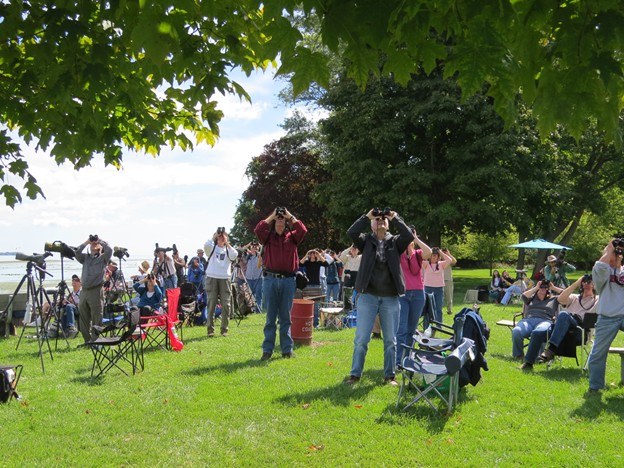
Featured image: Citizen counters of the annual Detroit River Hawk Watch. (Photo Credit: Detroit River Hawk Watch)