
“Nibi Chronicles,” a monthly Great Lakes Now feature, is written by Staci Lola Drouillard. A Grand Portage Ojibwe direct descendant, she lives in Grand Marais on Minnesota’s North Shore of Lake Superior. Her nonfiction books “Walking the Old Road: A People’s History of Chippewa City and the Grand Marais Anishinaabe” and “Seven Aunts” were published 2019 and 2022, and the children’s story “A Family Tree” in 2024. “Nibi” is a word for water in Ojibwemowin, and these features explore the intersection of Indigenous history and culture in the modern-day Great Lakes region.
Margaret Watkins and Taryn Manthey are water quality specialists for the Grand Portage Band of Ojibwe-Anishinaabe. As part of their work as biologists, they regularly monitor Lake Superior waters within Grand Portage Tribal lands, as part of the Band’s commitment to support “sustainable air and water quality, wetlands, fisheries, wildlife populations, and aquaculture.”
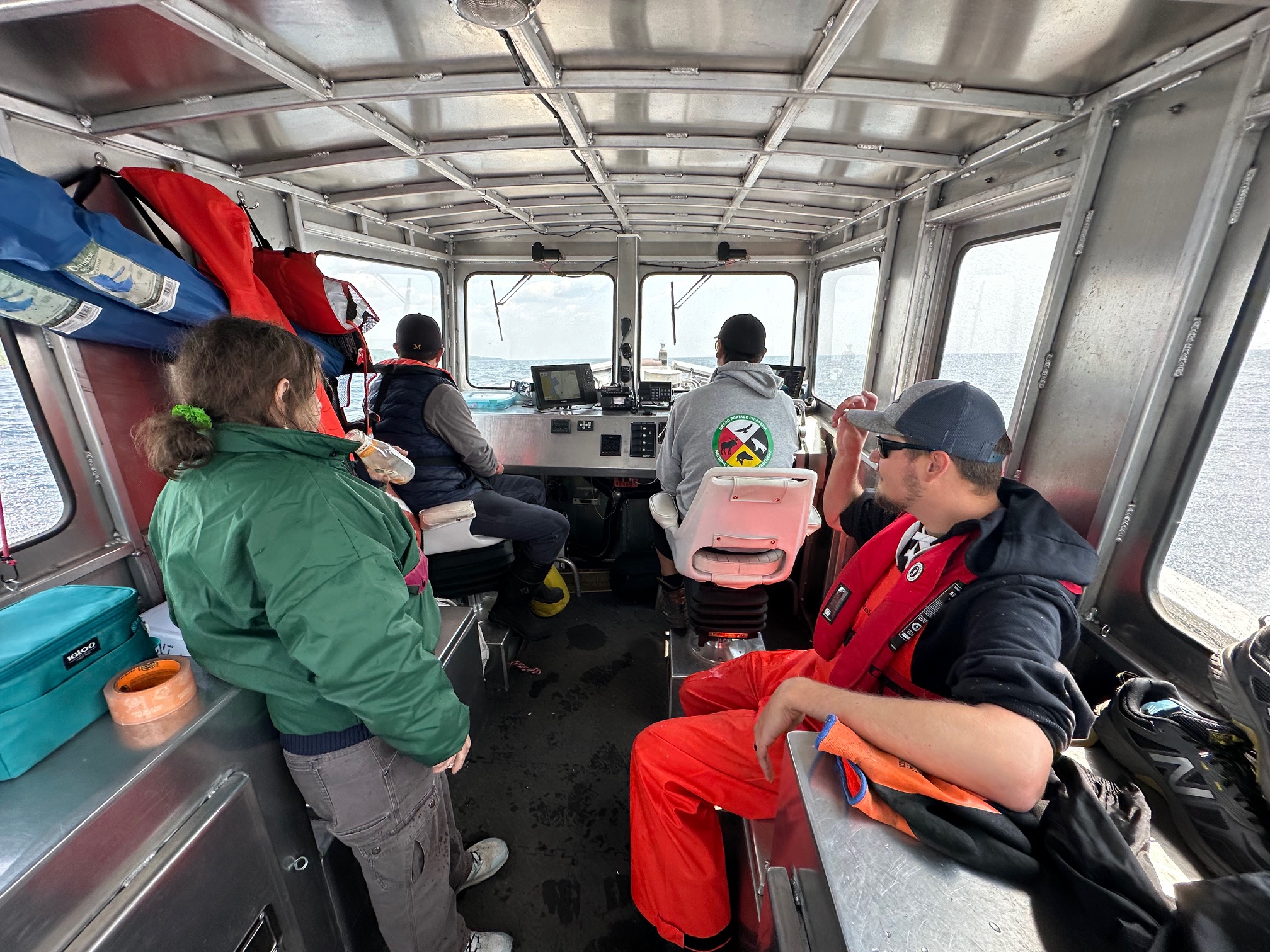
Watkins and Manthey recently participated in the National Rivers and Streams Assessment (NRSA), which is a partnership between the Environmental Protection Agency (EPA), state and tribal nations to assess the condition of rivers and streams across the United States. And on June 10, 2025, the Grand Portage team, in collaboration with biologists from the EPA’s Region 5 office based in Chicago, collected local data for the National Coastal Condition Assessment (NCCA). The results of these assessments help determine the health of estuarine and Great Lakes nearshore waters nationally and regionally, and for each of the Great Lakes separately.
Initial Grand Portage results “indicate that waters here have been kept in really good condition, in the 90 percentiles in the nation, for each assessment.” Which is good news for local water.
“We also are collecting algal samples along with other water monitoring activities to detect harmful algal blooms and algal community shifts related to climate change,” Manthey said.

The team is working with GreenWater Laboratories in Palatka, Florida to screen for potentially toxic cyanobacteria. Cyanobacteria (sometimes called blue-green algae) are often one-celled photosynthetic organisms that normally occur at low levels. Under eutrophic conditions — referring to bodies of water that have high levels of biological productivity due to high levels of nitrogen and phosphorus — cyanobacteria can multiply rapidly and create toxic conditions. The toxins released in these conditions include microcystins and cylindrospermopsin.
If cyanobacteria are found, Grand Portage biologists must then determine the concentration of toxins in the water.
“The U.S. EPA has set recreational criteria for swimming or other recreational activities in-or-on the water of 8 micrograms per liter for microcystins and 15 micrograms per liter for cylindrospermopsin,” Manthey said. “We use those values to determine if an area needs to be posted with an advisory.”
Water samples are processed by GreenWater Laboratories which formulates results within hours of receiving a sample.
GreenWater’s website offers this point-of-fact: “although the U.S. EPA has released 10-day health advisory guidelines for cylindrospermopsin and microcystins in drinking water, other toxins (anatoxins, saxitoxins) have still not been addressed. Further, there are still not any enforceable laws or regulations in place to protect the public from cyanotoxins in drinking water. Therefore, many tribal nations and states have adopted their own strategies for monitoring toxins.”
A quick review of standards for Lake Superior states confirm that Michigan has “no thresholds” in place. Minnesota has identified slightly different state-wide standards for both drinking water and recreation. Wisconsin follows the federal EPA Ambient Water Quality criteria.
Watkins and Manthey’s team is small but has a lot of water to cover. And the local conditions are changing, with algal blooms showing up in unexpected places: the cold water of Lake Superior, the lakes on Isle Royale and inland water-rich areas like the Boundary Waters Canoe Area Wilderness.
Manthey confirms that finding algal blooms in unexpected places has a scientific explanation, which is that “the warmer climate along with greater frequency of extreme weather events are creating ecosystem disturbances that are favorable to harmful algal blooms through increased run-off, water temperature, and turbidity.”
Manthey added that lack of water can also contribute to poor conditions resulting in, “reduced dissolved oxygen and water flow during extended periods of drought.”

No other state or local municipalities have yet to develop mitigation plans for areas that receive pollutants through what Manthey refers to as “air deposition” of pollutants. Grand Portage biologists rely on the 1854 Treaty Authority’s Climate Change Vulnerability Assessment and Adaptation Plan for mitigation strategies if harmful algal blooms are found.
The climate adaptation plan, published in 2016, recommends that tribal agencies:
- Continue to work with federal and state partners, conservation groups, private landowners and others to preserve or restore wetlands ecosystems in buffer zones along rivers, lakes and reservoirs for flood control and water quality management. Watershed management includes a range of policy and technical measures to preserve or restore vegetated land cover and manage stormwater runoff.
- Protect and mitigate existing impacts to the forests along the wetlands and riparian areas, and within the wetlands system.
- Create runoff control buffers in fire prone areas and stormwater retention projects to prevent adding contaminants into the environment.
- Develop flood management systems that utilize natural floodplain processes. Integrate flood management with watershed management on open space, agricultural, wildlife areas and other low-density areas to lessen flood peaks, reduce sedimentation, temporarily store floodwaters and recharge aquifers and restore environmental flows.
- Implement more stream bank erosion control strategies (promoting land use practices that reduce erosion, add buffer along streams, look at forest management practices along stream banks).
Manthey explains that the Algal Community Surveillance Project for microcystins and cylindrospermopsin includes a rapid response plan by providing “risk-based guidance for recreational activities where exposure to the toxins produced could cause illness or interfere with the preservation of native fish and aquatic vegetation in nearshore areas of Lake Superior and inland bodies of water.”
I asked how local monitoring sites are selected and Manthey confirmed that locations are based on recreational use and include a mix of streams, Lake Superior beaches, inland lakes where people fish and swim and wetlands used for subsistence harvests.
Local results at Grand Portage, so far, have identified cyanobacteria in one inland lake, but no cyanotoxins.
The team will be collecting 57 samples this season — or 19 per month, which began in June. GreenWater Laboratories anticipates that algal community structure data will be available in December of 2025.
Results of future NRSA and NCCA assessments are anticipated, but also carry a sense of uncertainty. On July 18, 2025 the EPA announced a reduction in force (RIF) focused on the Office of Research and Development (ORD), the scientific research arm of EPA.
Watkins acknowledged how the research done by scientists at the ORD guides work being done at the local level.
“Our last water quality standards triennial review updating criteria for nutrients, conductivity, and aluminum, used a method for calculating the values based on work by Susan Cormier and others at ORD,” Watkins said. “We have lots of interactions and partnerships with EPA all over the country.”
Catch more news at Great Lakes Now:
Where the strawberries still grow
The Legacy of Chief Blackstone: Ojibwe resistance in Great Lakes history
Featured image: Biologists from Grand Portage and the US EPA collect water samples for the National Coastal Condition Assessment, June, 2025. (Photo courtesy of the Grand Portage Trust Lands Agency)