

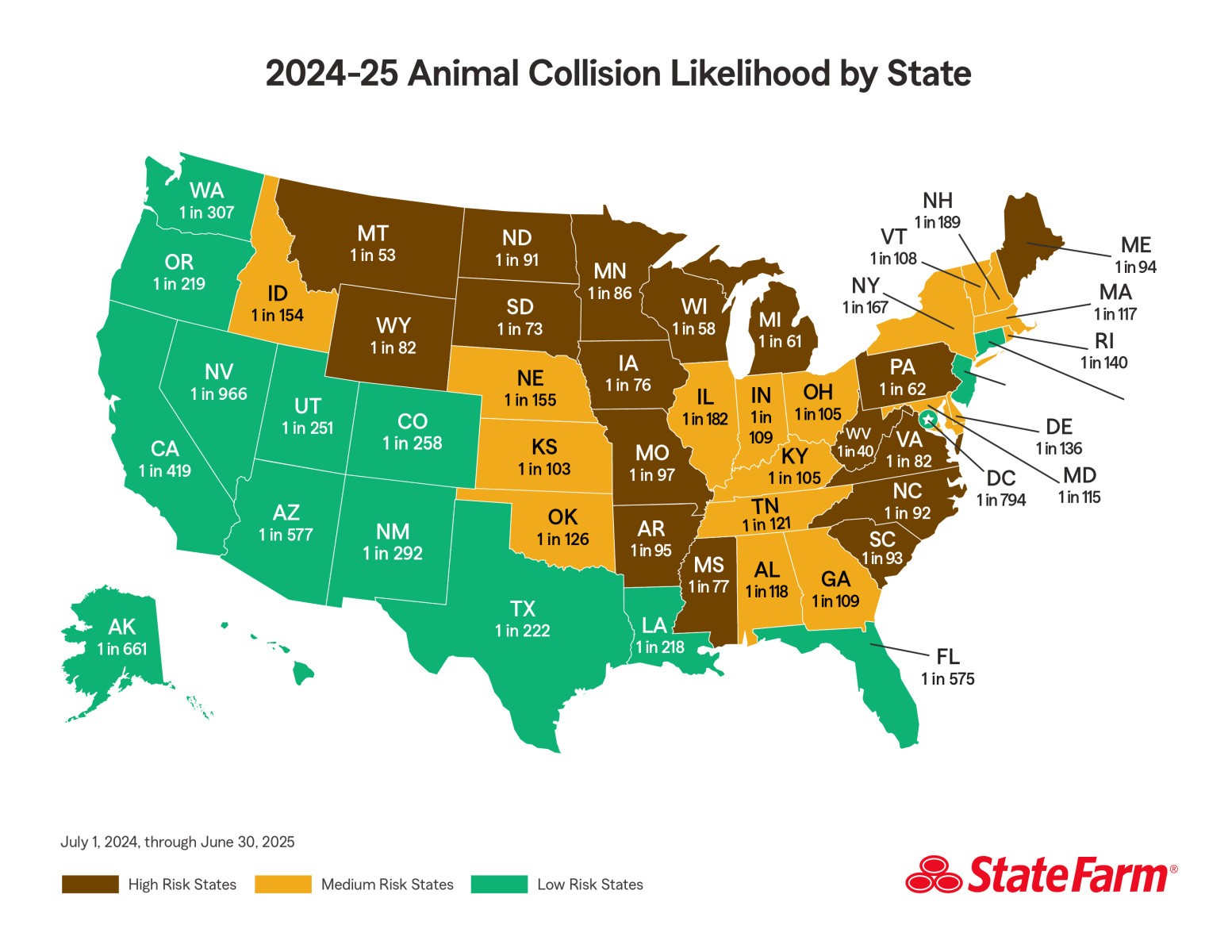
Drivers around the Great Lakes region beware. In the weeks following “fall back,” once daylight saving time ends, collisions between wildlife and vehicles rises by 16%. According to data from insurance company State Farm, October, November and December are the most dangerous for animal-related collisions, making up 41% of all animal collision claims. Among the top five states most at risk are Wisconsin, Michigan and Pennsylvania, although Minnesota is not too far behind with a likelihood of 1 in 86.
The insurance company also notes that, from July 1, 2024 to June 30, 2025, approximately 1.7 million auto insurance claims came from animal collisions. While there is a slight decline in claims from the year before, there was a 1 in 128 national average of being in an animal-related car crash — now it’s 1 in 139 — it’s still something transportation and environmental advocates alike want drivers to be more aware of as the seasons change.
“I think what it comes down to is that when you think about the upper Great Lakes, these are kind of the archetypal sportsman’s paradise, and we’re really proud of our abundant wildlife and natural resources here in Michigan and across the region,” said Calvin Floyd, conservation advocate with Environment Michigan.
According to a 2022 study from Current Biology, deer and vehicle collisions are 14 times more likely shortly after dark and are more frequent during standard time. Their research suggests that year-round daylight saving would reduce collisions, which could save approximately $1.2 billion annually.
Karla Griesbaum, environmental and energy stewardship educator at the University of Illinois Urbana-Champaign, said that dusk is when crepuscular animals (like deer) are most active. She said, there are a lot of evolutionary reasons for why they are active during this time of the day.
“The fall back time-switch also typically corresponds with the rut for deer, when deer are particularly active during their mating season,” said Floyd.
While Griesbaum said that some animals, like deer, can occasionally change their behavior based on human activity, there is still an adjustment period that is dangerous for humans and animals. Even though deer are the animals most known to be vulnerable to car collisions, so are rodents, dogs, raccoons and many other animals that are much harder to track like snakes and insects.
“We are worried about some of our smaller animal populations, like turtles and snakes and even pollinators that are getting hit,” said Griesbaum. “And that’s a little bit different from this whole time shift thing. This is kind of a road kill problem in general. There’s a road down in Southern Illinois that’s actually closed off for both the spring and fall to allow for snakes to cross this road or perish, because so many snakes were dying as cars were driving through there, because it happened to be in between their two main habitats for season shits.”
Between September 1 and October 30, the U.S. Forest Service (USFS) closes Forest Service Road No. 345 — also known as “Snake Road” — to vehicles and bicycles. They also close this road from March 15 to May 15, as dozens of snake species move from their winter dens to LaRue Swamp, where they find food for the summer. According to reporting from Outside Magazine, this part of the Shawnee National Forest houses 66% of Illinois‘ amphibians and over 90% of the state’s mammal population.
Closing certain roads isn’t the only strategy for addressing this safety issue, according to Floyd, adding wildlife crossings to road infrastructure are also a huge help. He said that we know when crossings are built with fencing — that leads animals to overpasses (for deer or elk) or culverts (for turtles or salamanders) — those are proven to reduce wildlife-vehicle collisions in certain areas by up to 97%.
“Michigan is home to some iconic and cherished wildlife like deer, moose, bears and one of the largest elk herds east of the Mississippi River,” said Floyd. “That core range is right next to I-75 in northern Michigan. And so I think it’s time to invest in wildlife crossings to keep wildlife and drivers safe.”
In December 2024, Michigan’s Department of Transportation (DOT) received a federal grant through the Federal Highway Administration’s Wildlife Crossings Pilot Program, to study and identify roadways that present the greatest risk to motorists and wildlife. Right now, the Michigan DOT is teaming up with the Department of Natural Resources (DNR), to work together on a statewide analysis of hot spots to determine where they could create key wildlife crossing locations. Floyd said, this is a big win for Michiganders.
As for other Great Lakes states, only New York was awarded funding from this federal grant in 2024. Though Pennsylvania did previously receive funding from this grant in 2023.
For the time being, Griesbaum said there are a few things drivers can do to keep themselves and the animals around them safe. First, just having an awareness that many animals are on the move this time of the year, especially around dusk and dawn. Also, checking for “eye shine” when driving in wooded areas. She said, you might not always be able to see the animal’s body in a forested area, but you’ll likely be able to see their eyeshine with car lights on.
Catch more news at Great Lakes Now:
What will the rise of floating solar panels mean for wildlife?
How are science and tradition saving sturgeon?
Featured image: Cars and motorcycles moving along a steep narrow road among a bright colorful autumn forest. (Photo Credit: iStock)