

Situated in a town of a little over a thousand people in Colon, Michigan, is an idyllic and pastoral outdoor dining experience just 250 feet from a main road. Guests are recommended to order a glass of wine, wander the property grounds, and soak in their surroundings before taking a seat at a banquet-style table. It’s become a hub for city folks traveling from Chicago, Detroit and Ann Arbor who are yearning to dine amongst tall timbers.
It’s the escapism of the space that appeals to urbanites. And here, they don’t need to sacrifice their sophisticated gustatory bud either. At Farrand Hall, they get a taste of both.
In 2017, partners James Gray and Jacob Hagan purchased Farrand Hall to get away from the commotion in Chicago. Before they settled down in Colon, Gray says their business was a “complete accident.” Their original plan was to host a few dinners on the property, but since Gray knows several chefs after working in operations and business development for food companies and says “it sort of snowballed into what it is today.”
Over a few years, they transitioned the property into a private dining location that highlights Midwestern chefs in their bucolic oasis. What began as 10 dinners a year has now grown to nightly dinners with resident chef Ken Miller and a weekend series with 20 guest chefs.
The weekend dinner series with Michelin-starred chefs and James Beard Award winners is almost sold out for 2025.
Farrand Hall is named after Henry K. Farrand, who built the Greek and Federal style mansion in 1854. Large oak and maple trees hide the property from the main road, where you’ll either hear loud roaring trucks or the hoofsteps of an Amish buggy.
When asked why they decided to leave Chicago, Gray said, “It was definitely the house. We fell in love with it and the tranquility of the location.”
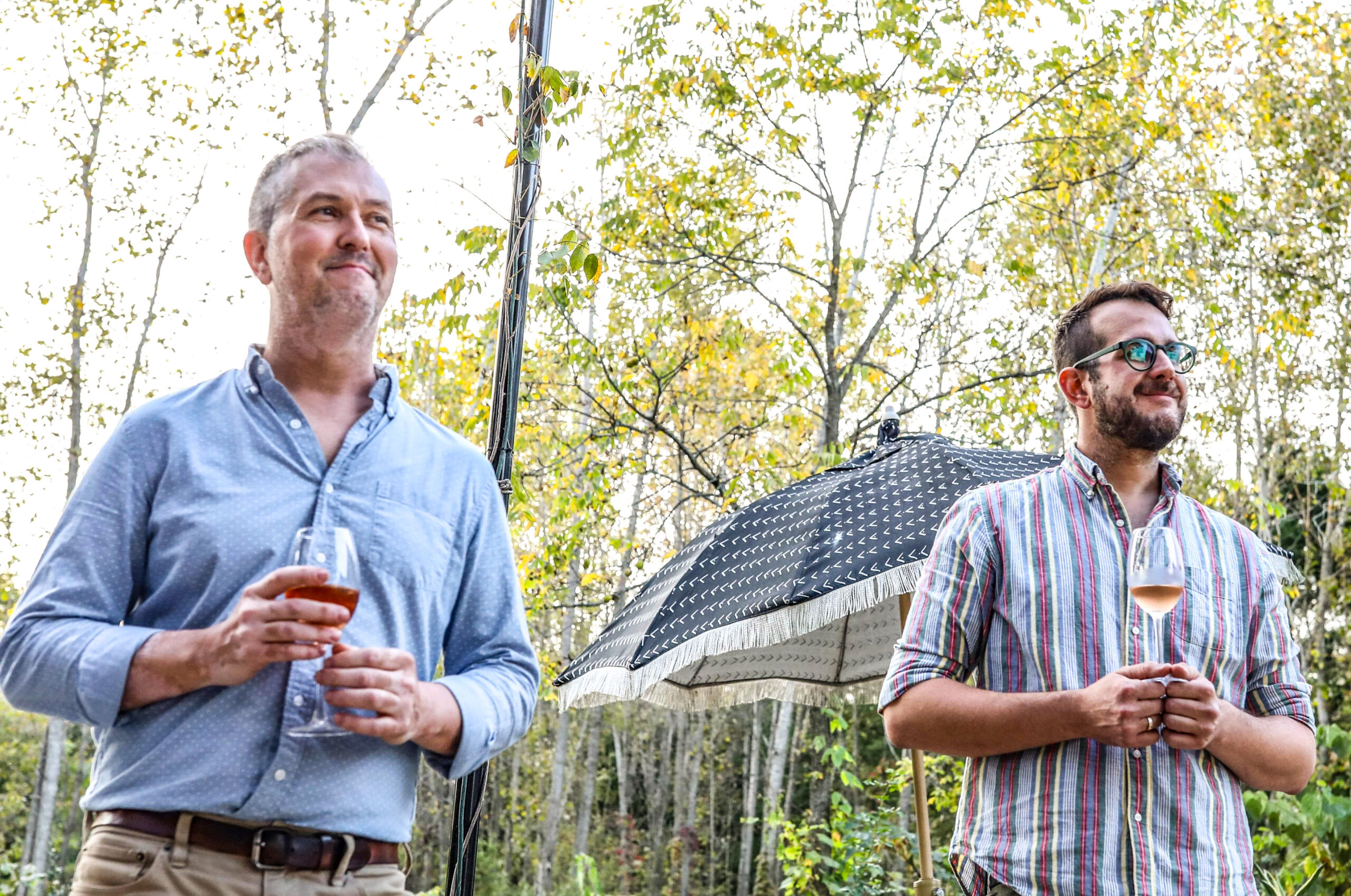 In 2017, partners James Gray and Jacob Hagan purchased Farrand Hall to get away from the commotion in Chicago. (Photo Credit: Farrand Hall)
The 4,000 square foot mansion, with a 30-foot entry hall and library with a fireplace, sits on 12 acres of property with a prairie, forest, gardens and a small pond plus two Scandinavian-style barn buildings. One barn is a lounge, and the other is an open-concept kitchen and indoor dining.
This year’s calendar chef roster included Zach Engel of Galit (Chicago), Sarah Welch of Marrow (Detroit), Jenner Tomaska of Esme (Chicago), Cheyenne Galbraith of Houndstooth Restaurant (Benton Harbor, MI), Greg Leon of Amilinda (Wisconsin), and many more.
Weekend dinners with at least five courses can be purchased through online tickets that range from $150 to $200 per person.
Weekday dinners with Miller are $95 per person.
Miller is from the Flint area but spent the earlier part of his career in Chicago. Miller and his wife, Ashley Miller, started a seed-to-table pop-up restaurant concept that was focused on sustainability, local food and reintroducing people to wild and natural ingredients. He describes it as “culinary activism.”
After finishing up a residency at Host in Utica, Michigan, Farrand Hall had an opening seven months ago, and Miller hopped on the opportunity. Miller grew up in the garden with his grandparents and out in the woods. For him, coming to Farrand Hall “just feels right.”
“It was a very natural alignment of philosophy,” Miller said. “The aesthetic that Jacob creates is very much in line with my style of food. Everything fell together.”
Miller’s interest in sustainable practices at Farrand Hall is reflected in his method of preparing menus.
“We don’t build menus and dishes based on egos,” he said.
Near the community dining table, up a small hill, is a wildflower garden where Miller explained that many of the garnishes here are used in the dinners. For Farrand Hall, it all begins with what they have access to and less of what they want to cook.
Many dishes are inspired by preserved waste from prior dishes. He described it as circular.
“We design the menu to prevent food waste [which] now inspires the next menu and the next menu and the next,” Miller said.
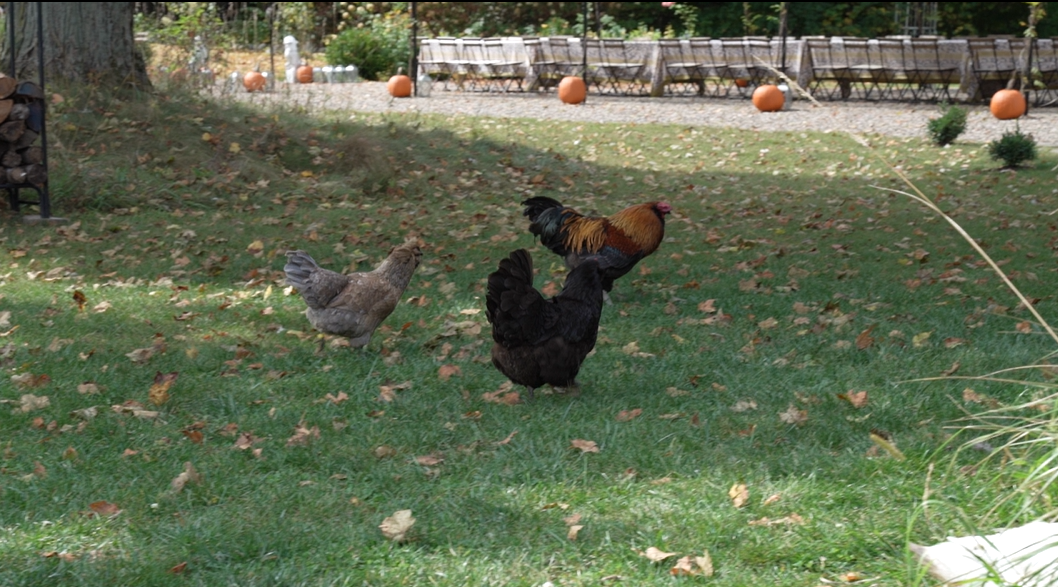
Whatever fails or doesn’t make sense for the menu goes to the chickens.
This type of practice isn’t new, of course. Farm-to-table restaurants have been around since the 1970s in the United States, with Alice Waters holding claim over the West Coast and Dennis Foy being called the “founding father” of the movement on the East Coast.
Despite being located in the corn belt, there aren’t many farms that offer a culinary experience in the Midwest. Larger cities dominate the farm-to-table concept despite the surrounding areas having some of the most farms in the country.
Farmers’ markets and farm stands are the main market for connecting producers with communities.
And the farm-to-table concept has evolved and changed through the years as well. It once meant that restaurants were working with a local farm, but this term has broadened in definition and doesn’t necessarily mean a restaurant is working with a direct farm source, but a combination of farms and farmers’ markets. Some restaurants utilize the term as a marketing tool to attract folks who are interested in sustainability.
Not many farm-to-table restaurants are located on an actual farm. Even Chez Panisse is sandwiched between other buildings in the bustling city of Berkeley, and De Floret has a small patio on a busy street.
Farrand Hall is in the grass among the lavender and wildflowers. It’s nestled by the coop where the chickens roam near your table — too skittish to get too close, however. There’s a shy rooster nearby, and the home of the owners is visible in the distance with the stately columns glowing as the sun sets.
You’re on the farm at Farrand Hall, in the thick of the country. What you’re eating is either directly sourced from the ground you’re stepping on, purchased from farms in Michigan, or even donated by locals who have extra ingredients.
Earlier in the evening, Miller was tied up chatting with a patron who had extra rhubarb and gooseberries that she wanted Farrand Hall to use.
“That’s where it starts, right?” he said. “I’m always walking around this flower bed out in the woods, staring at the neighbor’s property to see what else is growing. The dishes change week to week just based on what’s available.”
Since Farrand Hall works with the rotating guest chef series, Miller may use ingredients that are left over. For example, prawns aren’t normally on the menu since there isn’t an ocean nearby, but to avoid waste, he included grilled prawn with green gooseberries and pine on the menu. A former visiting chef over the weekend had included prawns in the menu and had several to spare. Miller says that although it didn’t fit conceptually with his menu, it would have been irresponsible not to use them.
Menus by Miller are refreshed monthly, but certain dishes will change weekly since certain ingredients — for example, a wild violet dish — are only available for a short period.
“The people who got to experience that dish were the only ones,” Miller said.
For other meals, Miller wood-fires several guinea hens a few feet away from the table and serves them with nasturtium butter. A jellied hen consommé with salted cream and foraged herbs melts in the mouth, while dessert includes spent wine with blueberries.
Miller wants to capture the special moments within the season rather than trucking ingredients in from elsewhere.
“We much prefer to celebrate those moments and then be happy that it happened and just move on,” he said.
As for wintertime, Farrand Hall begins hanging herbs and flowers to dry for the dinner series meals. They place more emphasis on storage and preservation in the colder months than in summertime. They close in January for a refresh.
The driving force behind Hagan and Gray’s vision is to make Farrand Hall an emblem of community. The dinners are long at Farrand Hall, stretching to at least two hours, where visitors can get up and meander around the property, but most are entrenched in conversation with their neighbors.
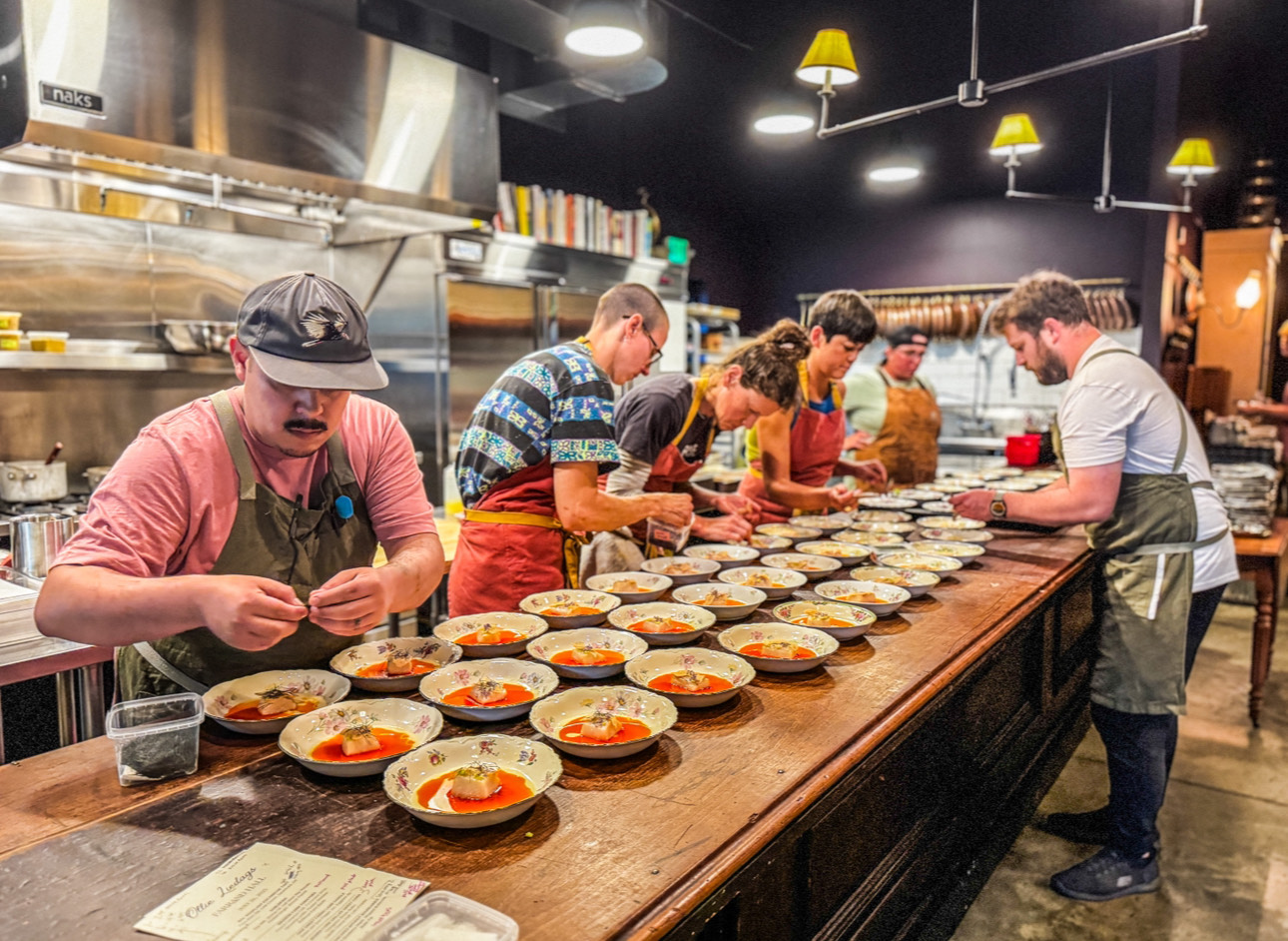 Menus by Miller are refreshed monthly, but certain dishes will change weekly since certain ingredients are only available for a short period. (Photo Credit: Farrand Hall)
Most of the guests are from Chicago. It might sound a little excessive to travel 2 ½ hours away from Chicago to find fellow Chicagoans and make connections. But here it is, Farrand Hall working its magic as the long community-style dinner tables force patrons to interact with one another, share stories, exchange information and stay in touch long after the dinner plates have been cleared away.
Jessica Brinkley DeMeester drove from Grand Rapids to meet her friend from Chicago and said she had been admiring Farrand Hall from afar. “It turned out to be a feast not just for the body, but for the eyes, soul, and spirit—walking the manicured woodland paths, sipping wine in the garden, and sharing laughter with new friends at the long family table—it’s a night I’ll treasure forever.”
By creating a gathering space that marries elevated cuisine without the stuffiness and fussiness of an indoor dining environment, Farrand Hall is both majestic and unpretentious.
As for the people of Colon, Miller said it can be more difficult to invite locals to the property to dine.
“It’s a pop-up in the middle of rural America,” he said. “Starting to do elevated experiences or trying to push the boundaries can be harder.”
Michigan has one of the largest agricultural systems in the country, but the products and produce are shipped out. At Farrand Hall, rural revitalization is a large part of the concept.
“We are trying to reintroduce people to food that is being grown from around here,” he said.
Many of the farms in the state grow and sell to Michelin-star restaurants in Chicago. And the people who grow the food and live amongst the food should have the ability to eat it in their own background.
Additionally, Miller said, “We’re not just creating an elevated experience. We’re also creating jobs.”
There’s a bit of a Farrand Hall empire growing in Colon. The downtown features Farrand Hall Bakery & Cafe and the Farrand Hall Market & Workshop with a total of 24 employees.
Farrand Hall is also a 501c3 non profit and they offer culinary internships for aspiring chefs who want to learn about local food systems and sustainability in restaurants. The short-term internship offers chef training and hands-on farming.
According to Miller, they don’t just want to celebrate people who have a more privileged background.
“We want to lift up and celebrate people who are more nose to the grindstone,” he said.
Overall, Farrand Hall has its hands full, and the owners are excited to overflow them.
As for the future, Gray said, “We are working on the next phase now, a much larger property that will house lodging, a full-scale restaurant, and vegetable and flower gardens that the public can come and enjoy.”
What started as their own getaway from the city is now being shared with visitors from near and far. It’s almost like Gray and Hagan can’t help but share their paradise and educate others on sustainable practices, indulge in good food and conjure up conversation over wine — and who can blame them?
Catch more news at Great Lakes Now:
From Waters to Table: The story of the Great Lakes whitefish
Culinary masters aboard Great Lakes freighters: Navigating the high seas of flavor
Featured image: Despite being located in the corn belt, there aren’t many farms that offer a culinary experience in the Midwest. (Photo Credit: Great Lakes Now)