

From our friends at Great Lakes Today: Leaky sewers and septic tanks send bacteria into the Great Lakes each summer, forcing beaches to close temporarily. To find the problem pipes, some cities and towns are getting help from an unlikely source: man’s best friend. Near the shore of Lake Michigan, WMUK’s Rebecca Thiele follows a team of dogs that are trained to sniff out contaminated water.
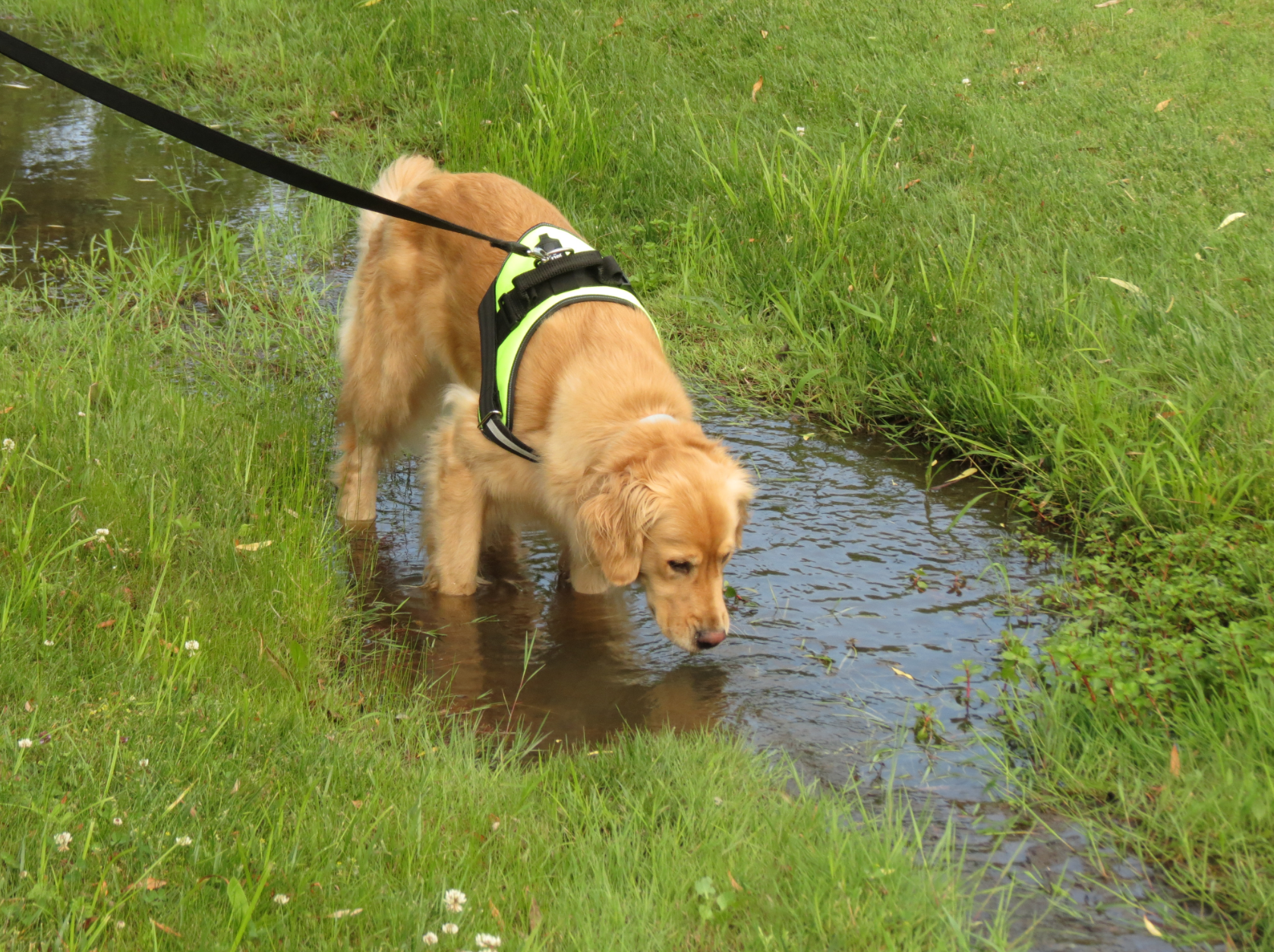
In the town of Bridgman, Mich., investigators Sable and Kenna sniff samples from storm water drains near a beach. Sable is a 10-year-old German Shepherd. Kenna, a Golden Retriever, is 2.
The dogs have been trained to sniff out polluted water, says Karen Reynolds, co-founder of Environmental Canine Services.
“And if they smell any contamination that indicates human source bacteria, then they will give an alert,” she says. “Sable barks when he smells that and Kenna will sit.”
Today, the dogs are following a creek along the railroad tracks. Several area beaches have had problems with pollution and they’re looking for the source.
Suddenly, Sable barks.
Peg Kohring, Midwest director of The Conservation Fund, says the dogs find things that people can’t.
“I’ve walked those creeks many times looking, didn’t see anything and then this dog Sable just came and nailed it – found that pipe under all these leaves,” she says. “So it’s faster, it’s much cheaper than water sampling. We can go right to the source of the problem.”
Reynolds says regular water testing is still important. But the dogs, she adds, can point scientists in the right direction — especially when there are two storm drains like these.
“So traditional methods we would have had to grab a sample from both, send it to the lab, it would take about 24 hours to get E.coli results back,” Reynolds says. “Then you’d have to come back out and start tracing it upstream that way. Now we just did it all in matter of minutes.”
On this trip to Bridgman, Kohring says the dogs found whole sewer lines that had been dissolved by sewer gas. The team also discovered that some sewer lift stations — which pump wastewater — were leaking into nearby creeks.
The U.S. Environmental Protection Agency has approved the use of the dogs for past projects in Michigan and Wisconsin. But, this method isn’t perfect.
Environmental microbiologist Patricia Holden of the University of California, Santa Barbara conducted a study on the dogs two years ago. Overall, the dogs were accurate. But there were a couple of times when they would alert when there was no sewage.
Holden says the dogs were also trained to smell detergents — and that could have thrown them off.
“It could very well be that that detergent was also in the environment because of other activities unrelated to leaking sewer pipes,” Holden says.
Reynolds’ company started in Michigan but now is based in Maine. It has teams on both coasts as well as in the Midwest. All together they have six dogs.
And they don’t mind the work, she says.
” It’s like any scenting dog that you train, the goal is to make it a game for them where it is the most fun thing that they do,” Reynolds says . ” They always get a reward of a treat or a squeaky ball or whatever it is. So they love it.”