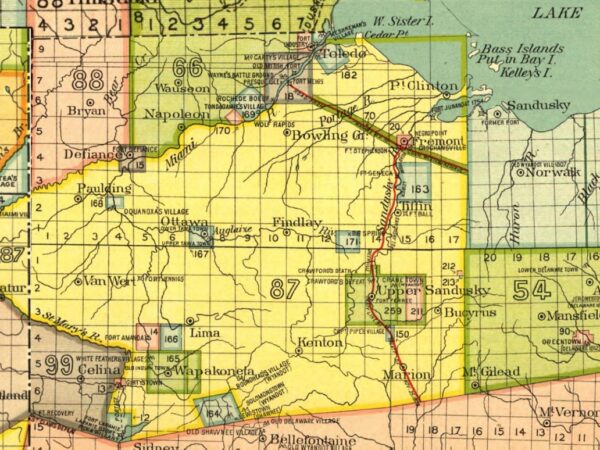

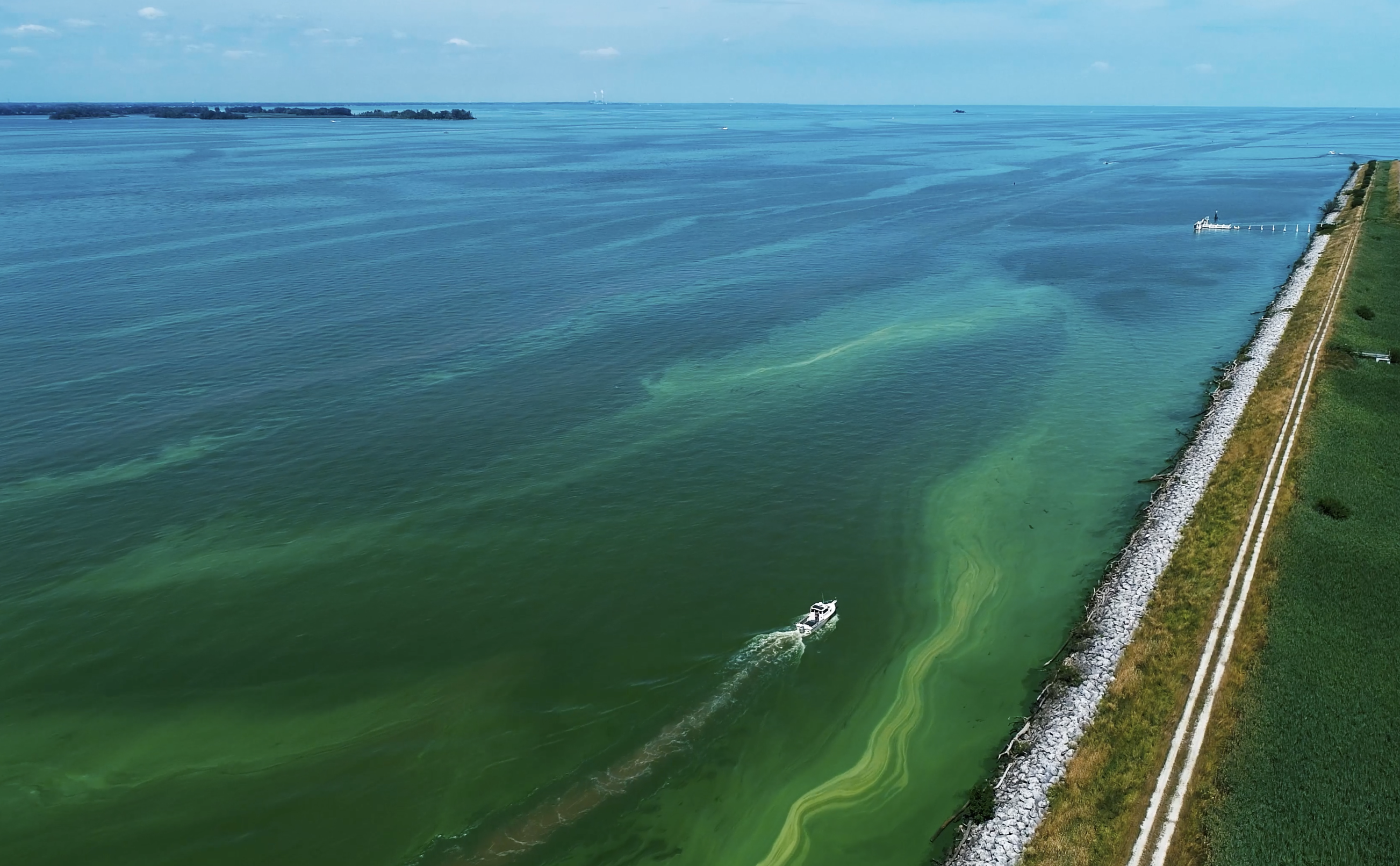
It’s the annual peak algal bloom season and the spotlight as usual, is on Lake Erie’s western basin, including Toledo and southeast Michigan.
For the public, that’s because in 2014, Toledo went three days without drinking water as toxic algal blooms forced the city to issue a “do not drink” order. The order was more severe for children and people with compromised immune systems, who were told not to even bathe in it.
The National Oceanic and Atmospheric Administration’s (NOAA) annual size estimate of the algal bloom is anxiously awaited at this time of year, especially by the agencies with responsibility to deal with the bloom and the advocacy groups who have tracked the blooms well prior to the 2014 Toledo crisis.
In late June, NOAA forecasted a “mild to moderate harmful algal bloom” for western Lake Erie. The agency cautioned that the size of the bloom is not an indicator of its toxicity.
However, as NOAA’s annual report is still anticipated, its release hasn’t generated the level of interest it did shortly after the Toledo crisis. And there hasn’t been a recurrence of what Toledo experienced.
The NOAA forecast that projects algal blooms “has become the new normal,” said Joel Brammeier in a press release. Brammeier is President and CEO of the advocacy group the Alliance for the Great Lakes.
Brammeier highlighted that the “current use of solely voluntary measures to reduce the blooms has failed to meet the phosphorus reduction targets agreed to by Michigan and Ohio.”
In 2015, the states pledged to reduce nutrient pollution to Lake Erie by 40% by 2025. Federal and state governments have been loath to consider regulation, instead continuing to rely on financial incentives to secure action by farmers.
“We need to be honest with ourselves,” said Angela Blatt, the Alliance’s Senior Agriculture Policy Manager, responding to a Great Lakes Now inquiry.
“To meaningfully reduce nutrient runoff costs money —and it will require collaboration and regulations that allow an economically vibrant agriculture system to thrive, while ensuring safe and clean water as part of that system,” Blatt said.
Even on funding, Brammeier noted that Ohio has reduced funding to the H2Ohio program by 39%. The initiative launched in 2019 is the centerpiece of Ohio’s efforts to combat harmful algal blooms.
The Ohio Farm Bureau in a statement on the budget did not comment on the funding cut to the H2Ohio program but said: “while Ohio continues to lead efforts to improve water quality, those enrolled in the H2Ohio program will be able to continue to use these resources to display positive results for the next two years of sustained funding through the budget.”
At the federal level, EPA Great Lakes region spokesperson David Shark told Great Lakes Now that the agency’s support to reduce phosphorus and mitigate harmful algal blooms falls under the agency’s stated goal of “achieving clean air, land and water for every American.”
“Since 2010, phosphorus reduction and the mitigation of harmful algal blooms have been central priorities under the Great Lakes Restoration Initiative, leading EPA and partner agencies to allocate more than $200 million to address Lake Erie’s algae bloom challenges,” Shark said.
Ann Vogel directs the Great Lakes EPA office, recently coming from Ohio, where she directed the Ohio EPA. The office did not respond when asked if Vogel would support regulations on nutrient runoff to Lake Erie. Previously, Vogel declined an interview request to discuss her priorities for the Great Lakes.
While Ohio has long been in the spotlight for algal blooms, Michigan also plays a key role in reducing phosphorus levels in Lake Erie. Great Lakes Now asked the state’s Department of Environment, Great Lakes, and Energy for the status of action to protect Lake Erie from harm due to toxic algae.
“We are using a multifaceted adaptive management process and implementing innovative approaches working with the agricultural community to further reduce phosphorus,” agency spokesperson Jeff Johnston said.
Johnston listed nine activities where the state is currently engaged. They include a performance-based conservation adoption program intended to drive water quality improvements, and a Healthy Soils, Healthy Waters project that increases producer knowledge of soil health and water quality. Both are managed by the Department of Agriculture and Rural Development.
Asked if the programs are overly focused on activities like planning, modeling, monitoring and collaboration instead of outcomes, Johnston said, “we respectfully disagree with characterizing the plan as focused on activities rather than outcomes. The intended outcome of the plan is to reduce phosphorus loading into Lake Erie by 40 percent over the 2008 baseline measurement.”
On regulation, Johnston said, “state agencies have a limited ability to regulate agricultural nonpoint sources of pollution.”
Absent regulatory authority, “Michigan is focusing on the tools we have. This is primarily providing financial and technical assistance necessary to implement conservation practices where they will be most effective in meeting the load reduction targets and achieving the lake ecosystem objectives,” according to Johnston.
The Alliance for the Great Lakes’ call for regulation of phosphorus runoff to Lake Erie’s western basin is not unprecedented. Following a record algal bloom in 2011, the International Joint Commission (IJC) —the U.S. and Canadian agency that advises governments on transboundary water issues — released a report in 2014 titled “A Balanced Diet for Lake Erie.”
In it, the IJC called for state and federal governments to “strengthen and increase the use of regulatory mechanisms of conservation farm planning to reduce nutrient loadings.” The IJC is an advisory body and does not have regulatory authority.
Longtime Michigan policy adviser on Great Lakes issues, Dave Dempsey, was a member of the IJC staff and contributed to the 2014 balanced diet report. Great Lakes Now asked Dempsey to comment on the current state of Lake Erie related to managing harmful algal blooms.
Dempsey said Ohio and Michigan legislators are demonstrating that they are not serious about a healthy Lake Erie that requires public funds and enforceable rules that apply to at least the largest farm sources of nutrients. He referenced decades of taxpayer subsidies that he says haven’t worked or are not carried through over a span of years, and said more time and incentives are doomed to fail.
“Eleven years ago the International Joint Commission laid out these stark truths in its report, A Balanced Diet for Lake Erie. Apparently the truth is too much for some people” Dempsey said.
Catch more news at Great Lakes Now:
Toxic algae blooms are lasting longer in Lake Erie − why that’s a worry for people and pets
Featured image: Erie bloom boat drone. (Photo Credit: Great Lakes Now)