
New York’s Scajaquada Creek was the site of a more subdued, long-term environmental catastrophe compared to its infamous neighbor, the Love Canal. Instead of a chemical company burying thousands of tons of toxic waste over a couple decades, the suburban Buffalo stream was the site of industrial and municipal waste disposal. This went on for nearly a century before several miles of it were literally buried in a massive public works project in the 1920s. Only in recent decades has serious attention been given to transforming Scajaquada back into some version of a healthy stream.
“We like to say Scajaquada Creek encapsulates everything you could do wrong to a creek,” said Jill Spisiak Jedlicka, executive director at Buffalo Niagara Waterkeeper. “It’s only 13 miles long with a small watershed. It’s really an example of what not to do to a creek.”
Since before the turn of the century the stream, which forms in Lancaster about 14 miles east of downtown Buffalo, had been mistreated. For decades its main function was to carry away raw sewage in addition to a steady flow of waste from the region’s industries. Scajaquada Creek has remained in such bad shape that in 2014 western New York artist and conservationist Alberto Rey included it in his Biological Regionalism series which includes waters in the greatest of distress.
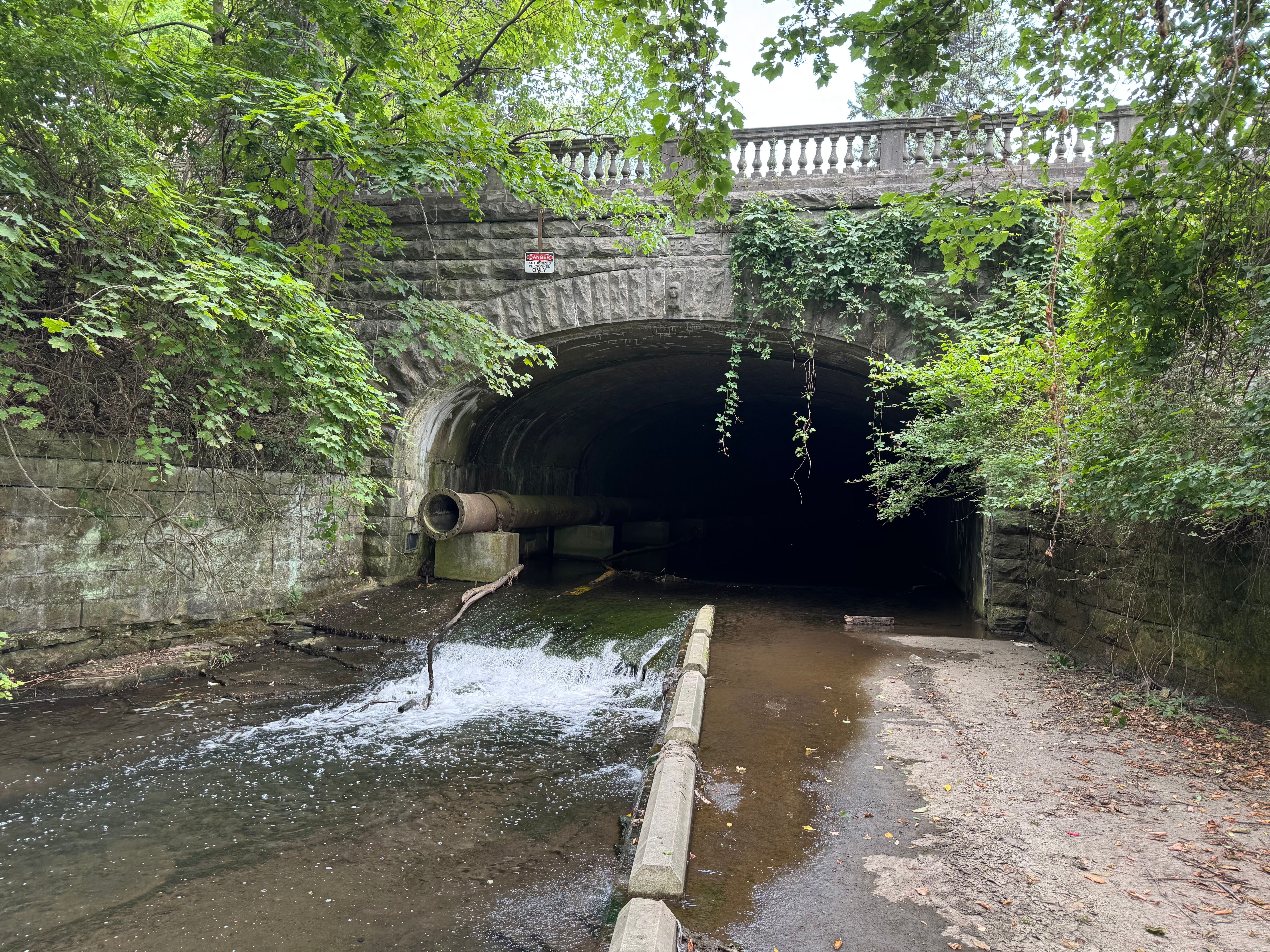
“It was buried because it was actually voted on in a public referendum in the 1920s. The creek was so polluted they said ‘The creek must go,’” Spisiak Jedlicka explained. “So they buried it underground, instead of addressing the problem.”
Subsequently, portions of the creek which were buried became new land that was later developed. Today there are roads and parking lots sitting directly atop the creek as it makes its way to the Niagara River near its confluence with Lake Erie, then Lake Ontario. In addition to hiding a portion of the stream a century ago, wetlands that once helped mitigate pollution have been largely eliminated in the name of development. A shopping mall was built in 1989 which destroyed 65%of the watershed’s wetlands. In addition, raw sewage dumped into the creek from municipalities meant the waterway was loaded with human waste and bacteria. According to The Investigative Post, in May 2014 raw sewage combined with stormwater overflow was dumped into Scajaquada on 283 separate discharges.
Reports from the same year indicate that decaying fecal matter covered the creek bed, as thick as five feet in some places. In addition, polychlorinated biphenyls (PCBs) and other dangerous chemicals were found in quantities high enough for the New York Department of Health to issue advisories against consumption of any fish from the stream.
Scajaquada sewage
While there have been murmurs of “daylighting” portions of the creek, the consensus is that’s not likely to happen. But in recent years, ideas and money have made their way into the hands of those working to fix the creek. While heavy industry is no longer the creek’s major polluter, the population at large is.
During the last several days of 2025, reports estimate that at least 37 million gallons of untreated or partially treated sewage flowed into the Buffalo-area waterways during a rain and snow-melt event.
Buffalo’s combined sewer overflow (CSO) system, where stormwater inundates city sewer systems during heavy rains, is currently the major polluter of the creek. During heavy precipitation events, stormwater flows into sewer lines beneath the city and when too much water inundates the system, the storm water combines with raw sewage and often flows into Scajaquada.
According to Rosaleen Nogle, principal sanitary engineer for the Buffalo Sewer Authority, more than 95% of Buffalo’s infrastructure is the CSO system, and that isn’t likely to change anytime soon.
“In an older city like Buffalo, it’s very difficult to separate because there’s so much infrastructure underground already,” she said, citing right-of-ways that include gas, electric and cable lines. “Not only is it much more difficult, it’s much more expensive.”
Nogle said the installation of innovative systems like “Smart Sewer” stations are helping to alleviate CSO events. Those systems open and close underground gates during heavy rains channeling stormwater into available underground pipes. Utilizing some of the city’s older and larger pipes to store CSO for future treatment prevents stormwater runoff combined with sewage from entering streams and rivers.
“Basically it’s storing in place using the excess space we have,” she said. “We have about 10 installations today and we’re continuing to advance the use of this technology to manage our system and store where we have the capacity, optimizing the amount of flow coming through our treatment plant.”
Overflows during storm events have led to litigation. The New York Department of Environmental Conservation filed its most recent lawsuit against BSA for failing to meet terms of a prior long term control plan. That litigation, according to Jedlicka, was a formality needed to reach a new agreement between the state and the Buffalo Sewer Authority in an ongoing effort to improve Scajaquada and other streams in the region.
Bright spots in a dark history
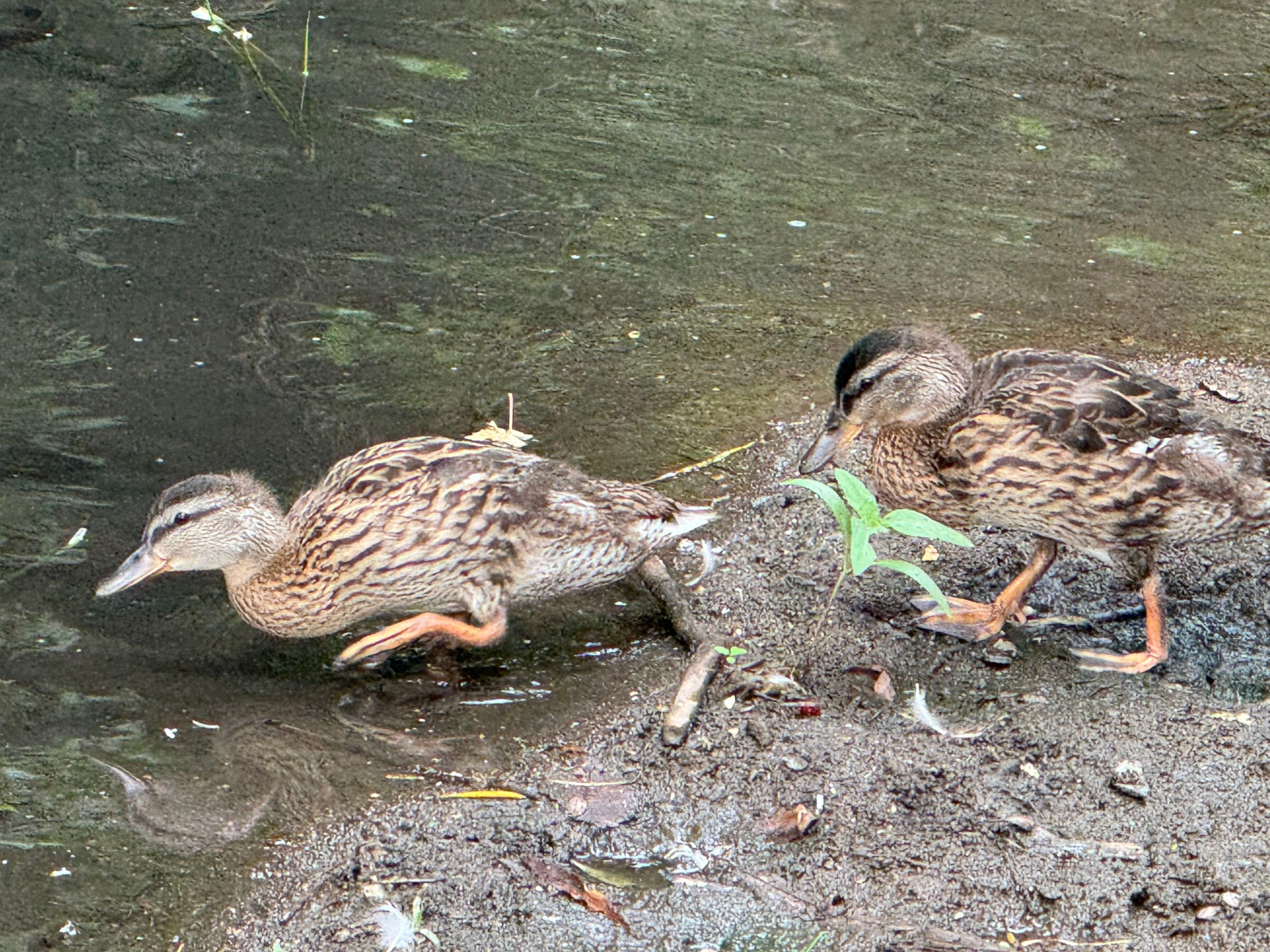
While there are plenty of downsides to Scajaquada, there are upsides, too. Like the fact that despite pollution, a wide variety of wildlife still call it home. Surveys included in a 2024 Army Corps of Engineers study indicates the presence of turtles, beaver, fox and mink in the stream and its smaller tributaries. Flying residents include songbirds, owls, hawks, ducks, herons and swans, among others. A surprising amount of fish species are also found in the stream.
Likely the most well-known residents are found at Forest Lawn, a 269-acre cemetery in the heart of the city. It’s the site where the longest hidden portion of the creek emerges from a tunnel.
“We have a lot of Canada geese here, I’d say that’s our bread-and-butter,” explained, Jennifer Kovach, executive administrative assistant. “Sometimes people mention coyotes, I’m not sure if we have any right now, but every so often we’ll get them. And we’ve had an owl that’s been nesting here so we have baby owls every spring and little mink that run through, and wood chucks. But the best-known is the deer. We hear about them every day.”
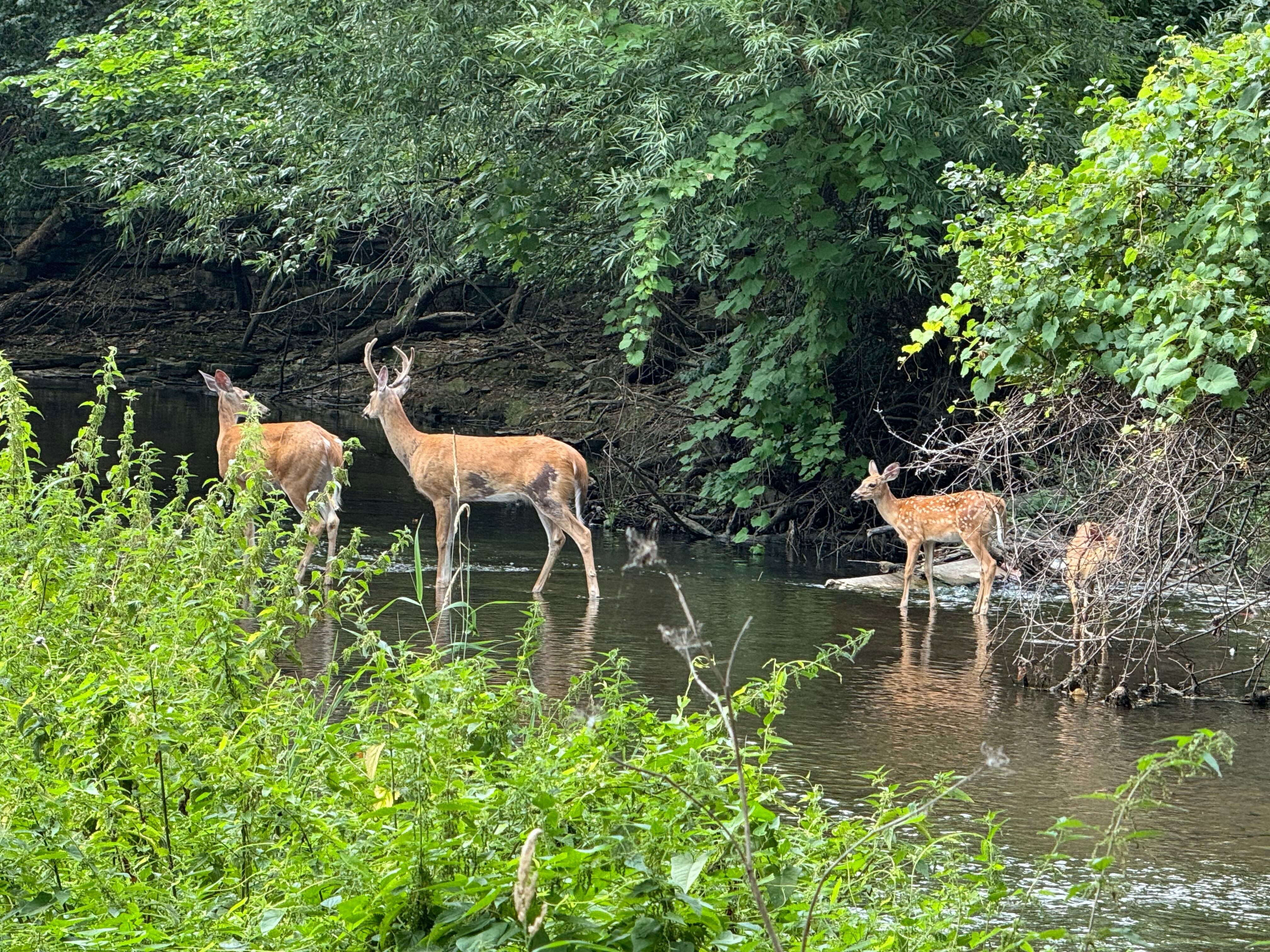
The deer she mentions are a small herd including several leucistic individuals (all white, yet not albino) that reside at Forest Lawn, on the banks of Scajaquada.
“One time we had a deer out on Delaware Avenue and someone called to let us know our deer left,” she chuckled. “I told them, it’s not our deer and they have free will so they can leave and come back, whatever they want to do.”
Kovach said because of the large number of trees at Forest Lawn, during spring the cemetery becomes a birding hotspot.
“We’re on the flight path for migrating warblers so lots of birders will come and literally stake out all day in the spring with their long lens cameras and get some spectacular shots,” she said.
According to Kovach, improvements to the creek are an ongoing endeavor.
“We work with Buffalo Niagara Waterkeeper and did a really big restoration project on the creek about seven years ago,” she said. “We’re constantly doing work on the creek. Down near the S-curves we restored the wetlands where it used to be kind of a big pit. Now it’s all native grass species and native trees and it’s really a beautiful area to walk around in.”
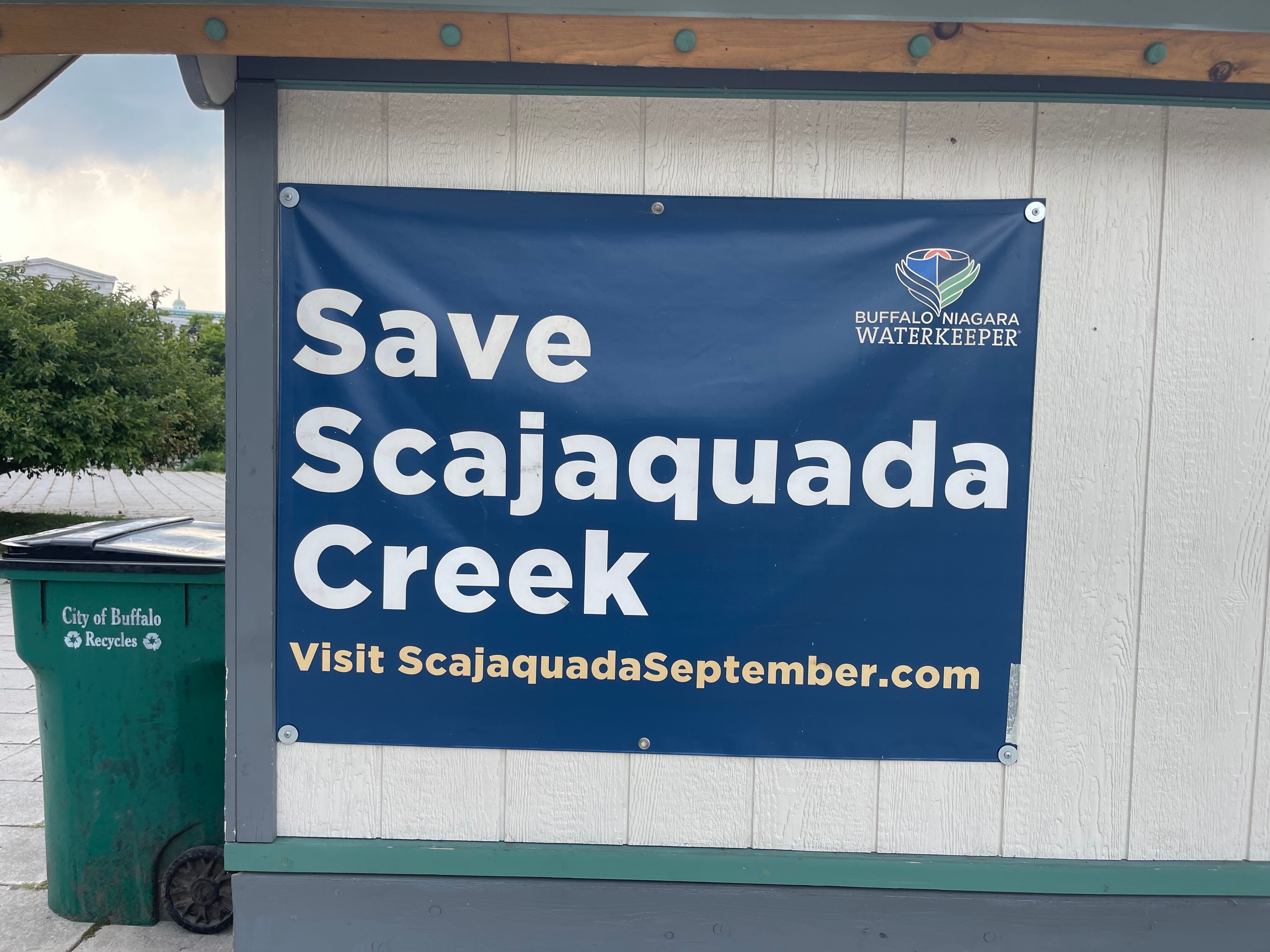
Waterkeeper is engaged in spring shoreline cleanups as well as smaller, focused cleanups in addition to public awareness campaigns.
“We’ve witnessed local anglers fishing it, in particular certain immigrant communities who rely on it despite the consumption warnings,” Jedlicka said. “They actually catch fish, like bottom-feeding carp and so we try to do some outreach with that. There are some people that paddle the headwaters, but for the most part in the lower creek people don’t come into contact with the water.”
New projects to help Scajaquada
Water quality improvement projects meant to help the stream were announced by the NYDEC on Jan. 17. The Buffalo Sewer Authority will receive $10 million to install infrastructure to reduce CSO events on both Scajaquada and nearby Black Rock Canal. An additional $10 million in water quality improvements will take place in the Town of Cheektowaga to renovate a half mile of sewer infrastructure including 1,200 manhole covers to reduce CSO during storms.
Jedlicka said ongoing partnerships have helped the efforts, including funding from the Margaret L. Wendt Foundation and the Ralph Wilson Jr. Foundation. And the continuing cleanup couldn’t be done without Mother Nature, as well.
“You have to remember the creek water isn’t polluted 100 percent of the time,” she explained. “It’s fed by clean, cold spring water so there’s a lot of natural inputs that help keep the creek alive so that when there’s not an overflow happening, it can sustain fish and wildlife which is why we keep working at this — if we can just eliminate as much discharge as we can and mitigate it, the creek will begin to repair itself. It’s not all doom and gloom.”