


By Christian Thorsberg, Circle of Blue
The Great Lakes News Collaborative includes Bridge Michigan, Circle of Blue, Great Lakes Now at Detroit PBS, Michigan Public and The Narwhal who work together to bring audiences news and information about the impact of climate change, pollution, and aging infrastructure on the Great Lakes and drinking water. This independent journalism is supported by the Charles Stewart Mott Foundation. Find all the work HERE.
Growing up in the shadow of a coal plant in rural Indiana gives a child a unique relationship with the passage of time.
As a little girl in the small town of Wheatfield, population 900, Barb Deardorff recognized the months by the height of the cornstalks and beansprouts which grew on her family’s farmland. The years were marked by what loomed beyond these fields — the R.M. Schahfer Generating Station and its ever-rising piles of toxic coal ash, their ascending silhouettes a scourge framed for years by her school bus window.
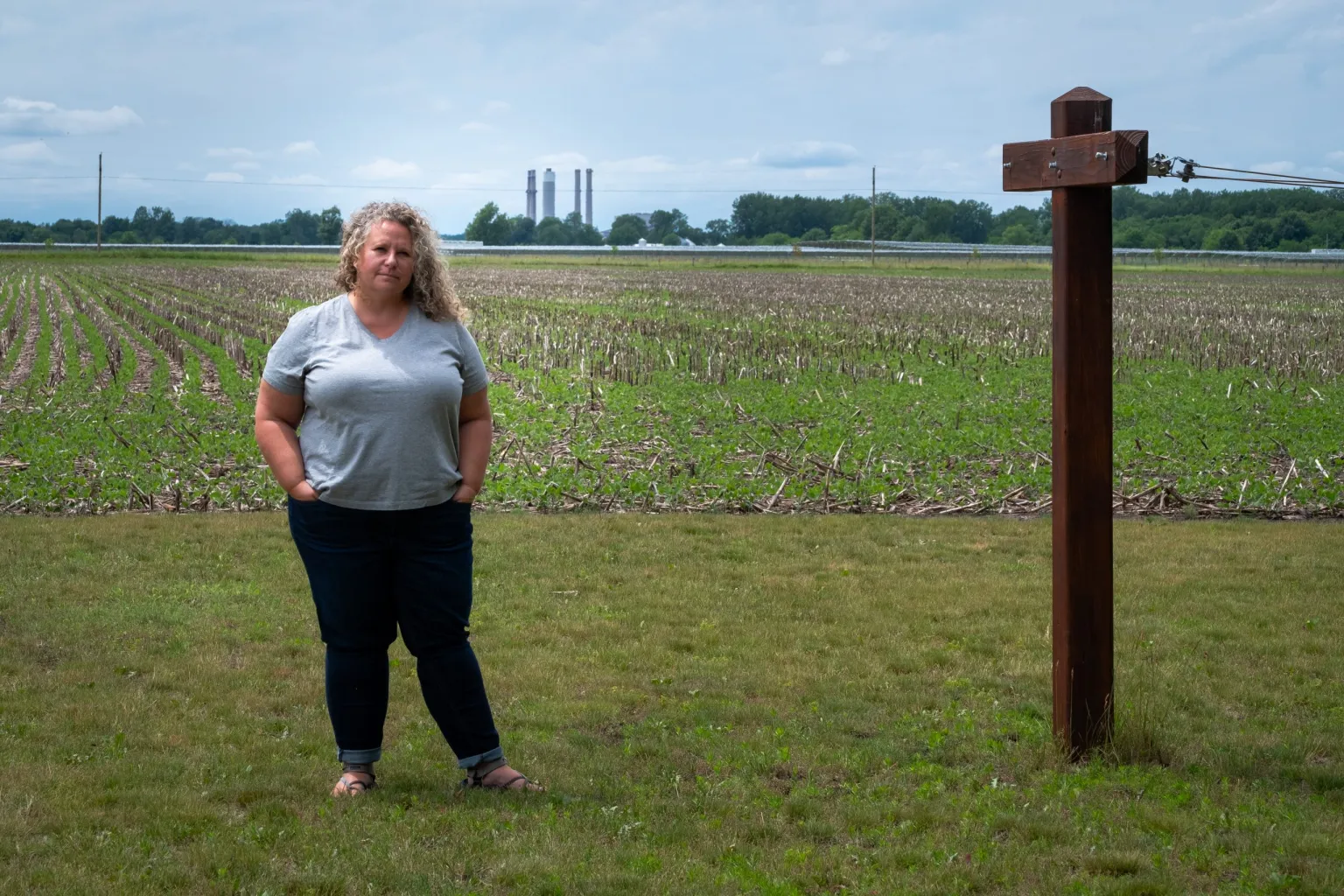
“My whole childhood, thirteen years, twice a day to and from school, I was watching the coal ash landfill build up layer by layer,” says Deardorff, now 50 years-old, in her Wheatfield home in June.
Deardorff’s kitchen today looks out onto a long, flat treeline, above which, just a couple miles away, the flues of that same half-century-old coal plant continue to billow smoke. They stand as readily visible emblems of an old energy era giving way to a new energy revolution that is putting fresh water, clean air, and human health at risk in small Great Lakes communities.
Wheatfield is a microcosm of industrial eras old and new. Having endured for decades the transformational effects of living in the midst of America’s 20th-century coal boom, residents are now left to wonder and worry how the age of artificial intelligence — bolstered by hyperscale data centers and the power plants they depend on — will affect their community.
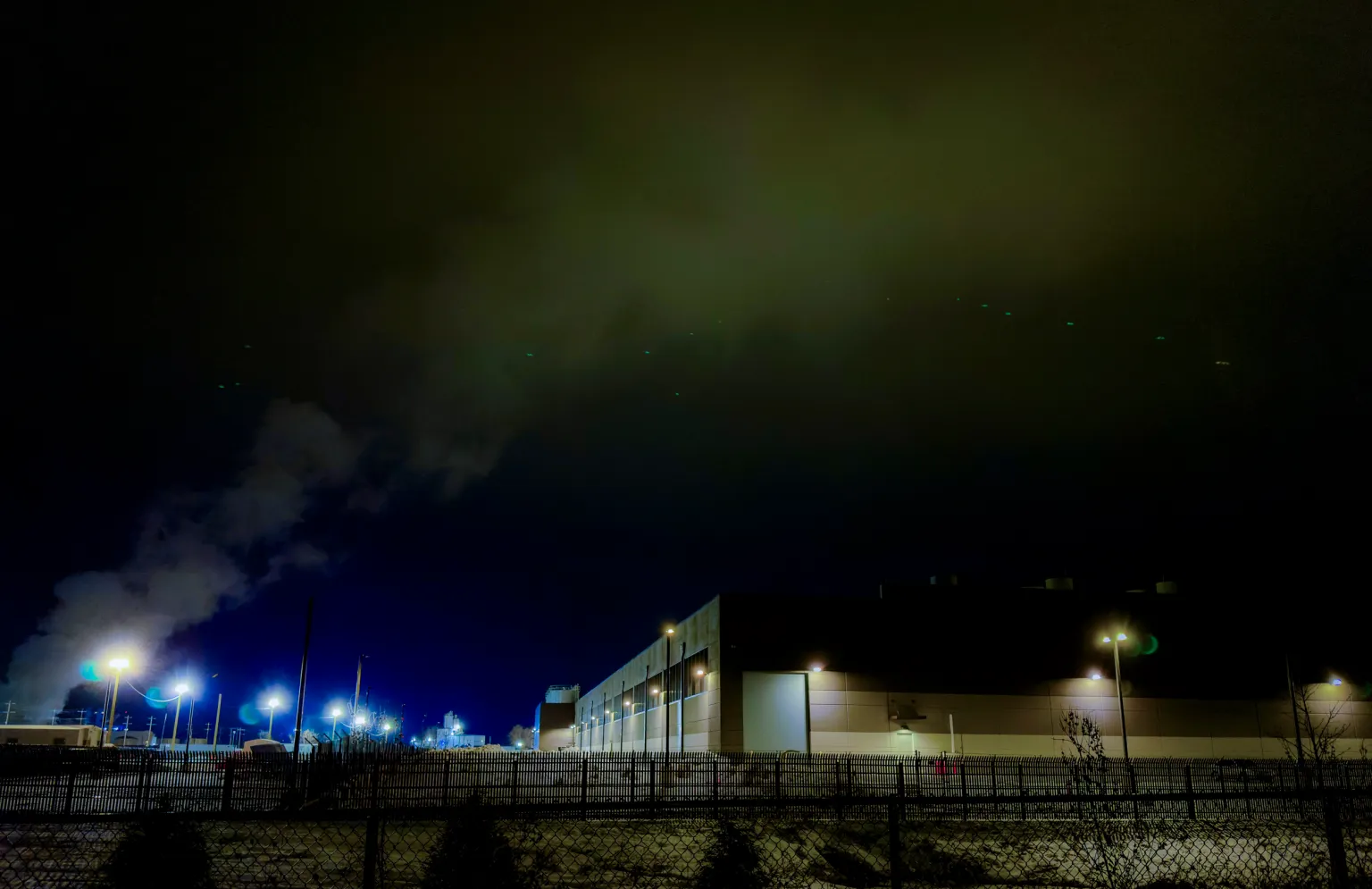
These concerns are justified. In the past two years, aided by state and federal policy, the tech giant Amazon has invested roughly $29 billion to turn Northwest Indiana into what it calls a new “Silicon heartland,” flush with three energy-intensive data center campuses, one already completed, spanning 2,200 acres. Next door to the Schahfer generating station, Indiana approved two natural gas-fired turbines for construction. Those plants are poised to power the newest Amazon installation — a $7 billion data center — and are estimated to consume roughly 6 billion gallons of water annually from the nearby Kankakee River.
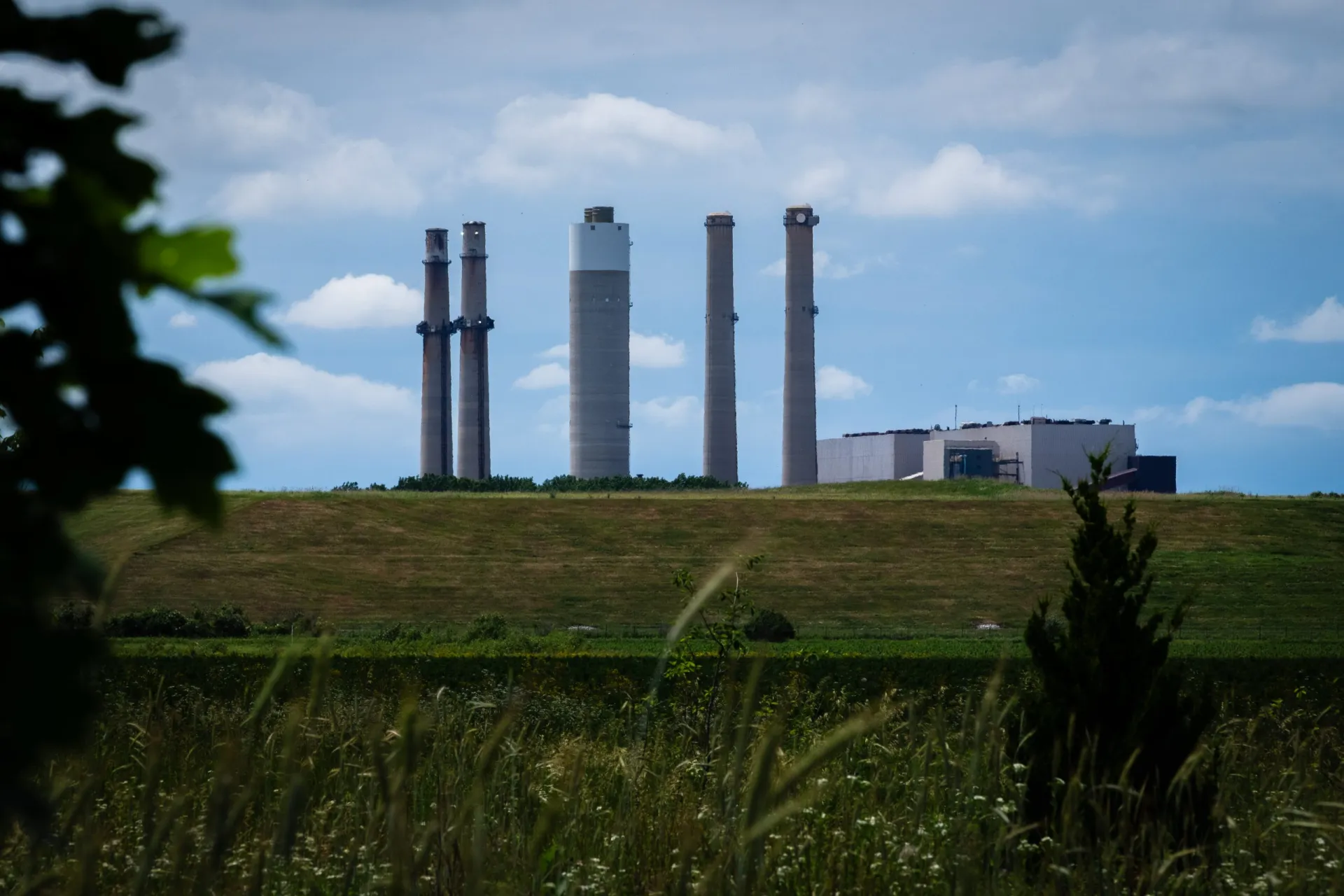
Amazon found a ready ally in the Hoosier state, which has embraced data centers and their thirst for power. Last year, state regulators granted the region’s primary utility first-of-its-kind authority to generate energy just for data centers. And in response to Trump administration directives, officials have re-written state energy policies to keep old coal plants — including Schahfer — operating to supply data centers indefinitely.
Experts anticipate that by 2040, more than one-fifth of Indiana’s energy needs will come from data centers alone.
The surge in construction investment and new power supply coincides with a comprehensive weakening of environmental protections on both the local and federal level — a risky proposition in a state that already is home to some of the most polluted waters, largest losses of wetlands, and worst air quality in the country.
Deardorff has a front row seat to a show of power and technology unlike anything seen before in this region, or across the country. Like other residents of rural communities bullied by data center construction, she says she feels almost helpless. As someone whose conception of time is inseparable from Schahfer, she says she feels suddenly entangled in multiple discouraging realities.
“Everything, everywhere,” she says, “is happening all at once.”
What Was and Is No More
Deardorff has reason to be suspicious of the mammoth display of technology and energy generation under construction around her home.
She has not known life without the R.M. Schahfer Generating Station as a neighbor. She was an infant when the coal-fired power plant opened its doors in 1976, and has lived next to its operations ever since, watching it become one of the country’s largest single emitters of greenhouse gasses. By one estimate, the plant causes 20 premature deaths each year from drifting soot and smog. And its groundwater, recent testing has shown, is contaminated with carcinogenic heavy metals — an existential threat for the dozens of residents who live within several miles of the facility and rely on shallow private wells as their sole source of drinking water.
So when Schahfer announced in 2018 that it would close its doors at the end of 2025, celebrations rang out for many. The prospect of life without the plant represented, literally, a brand-new horizon.
“I got emotional, because I thought we outlasted them,” says Deardorff, whose family has lived in Wheatfield for six generations and previously farmed the land where the coal plant sits. “We were here before them, we dealt with them, and I thought we were going to be here after them.”
Residuals of Ash
This dream was short-lived. Not only has a series of 90-day extension orders from the federal government kept Schahfer operational as usual into the present, but the plant’s legacy of waste and health concerns are crescendoing. Deardorff and others worry that the new landscape of data center and natural gas construction and operation could eventually produce more degradation.
At the Wheatfield home of Chris Hunter, a retired local farmer, coal ash’s stubborn tendency to permeate water and air lays bare. Just hours after severe thunderstorms and tornadoes tore through the town, Hunter’s wife, Cindy, ran a paper towel along the white exterior window sills of their home, located roughly two miles downwind from Schahfer.
Immediately, a dark, sooty film appeared on the pristine white background, the now-darkened paper towel a canvas that distills Wheatfield’s modern story.
“You just get it jammed down your throat,” Hunter says, looking out at the coal plant from his front lawn and thumbing through the wipe. “And we watch it all through our windows.”
In a state known for its high cancer rates — Hoosiers are nearly 12 percent more likely to die from the disease than the average American — Northwest Indiana where Hunter and Deardorff live stands out as a statewide hotspot for incidences of lung, colon, and breast cancers.
The statistics are made material in Wheatfield, where many residents living in the vicinity of Schahfer share stories of family members and friends who have suffered from poor health.
Deardorff recalls several neighbors and friends who have been diagnosed with cancer in recent years. Matt Mish, 35, who lives within a half-mile from the coal plant on his grandparents’ old farm, says that his grandmother died of cancer in 2015.
Hunter says he lost his younger brother at 52 years-old to a rare type of cancer, and his father to liver cancer at 62 years-old. His mother, 90, has lived with Parkinson’s disease for more than two decades.
“But how are you gonna really prove it,” Hunter asks, “and say it was [the coal plant]?”
All of these residents breathe Wheatfield air, and are among the dozens of people who rely on private wells to draw groundwater from the shallow local water table. Existential concerns for the quality of this supply were raised in 2018, when testing showed that Schahfer’s coal ash landfill had contaminated the plant’s own groundwater with cobalt, arsenic, lithium, radium, boron, and molybdenum in levels above federal thresholds.
Meanwhile, water samples collected at 107 wells in and around the plant between 2010 and 2019 found that 86 percent had at least one pollutant in excess of federal advisory levels, according to Earth Justice’s Ash Tracker dashboard.
“And we only found out about that because a law passed requiring [the plant] to publicly make that data available,” Deardorff says. “Who knows how long they had contaminated the groundwater before then?”
Indra Frank, a doctor and coal ash advisor with the Hoosier Environmental Council, says there is significant concern that the plant’s polluted groundwater will spread through the area’s shallow, flood-prone topography and contaminate wells and ditches that supply water used for drinking, recreation, and irrigation, especially as construction on the natural gas plant and data center begins.
The plant’s own ash-contaminated groundwater, held largely in unlined ponds spanning more than 80 acres, sits at least 15 feet higher than the groundwater that area residents depend on.
A one-foot-thick wall of slurry, which extends underground to a layer of shale bedrock, is all that separates the plant’s active waste disposal area (WDA) from the rest of the region’s aquifer. This setup, Frank warns, is precarious. Currently, the WDA receives an average of 2.88 million gallons of “bottom ash sluice water, boiler room sump discharge, and stormwater” per day, according to documents published in 2020.
“You’ve got 15 feet of water pressure trying to push that water out from under the slurry wall,” Frank says.
For a brief period, it was believed that federal intervention would spur remediation at the site. The EPA in 2015 announced a mandate requiring utilities to clean unlined coal ash ponds that were found to be leaking. But the requirement had several loopholes, Frank says, that the coal plant’s owner, energy utility NIPSCO, has exposed to delay any cleanup.
“They’re claiming that the ash pond is not subject to the rule, because water isn’t visible at the surface of the ponds,” she says. “Some of these ponds, which are 20 feet deep, hold 19 feet of sitting water beneath their solid top layer.”
The slow-walk to addressing its coal ash storage may have paid off for the utility, which last year produced 200,000 tons of ash. In April, the EPA proposed aggressive rollbacks to the 2015 rule, putting Wheatfield’s coal ash piles in a doubly prolonged state of limbo.
“It would wipe out requirements for half the coal ash in the country, and that includes some of the coal ash at Schahfer,” Frank says. “It can continue to sit there and contaminate groundwater. They could stop monitoring the groundwater for certain sites. It’s pretty, pretty devastating.”
That the Kankakee River runs directly adjacent to the Schahfer plant is another point of vulnerability. No systematic testing of soils or farmland in the area has ever been done, despite Jasper County being home to some 600 farms. Many of these crop fields rely on the Kankakee River for water, and are connected to both each other and the watershed through a series of drainage ditches. This network was created in the 20th century through the mass-draining of a massive wetland ecosystem once known as “the Everglades of the North.”
As a result of this degradation, most of the area, including some of the coal ash ponds, sit today within 100-year flood zones. Heavy, erratic precipitation made more likely by climate change could exacerbate the movement of contaminated groundwater through farmers’ ditches and crops.
According to a February report from the Hoosier Environmental Council, based on state data, 270 miles of rivers and streams in Jasper County are impaired. A one-off sample at a local irrigation ditch that runs adjacent to Schahfer, the Stalbaum ditch, was found to contain elevated levels of molybdenum. “That’s consistent with contamination from coal ash getting into that ditch, which runs into the Kankakee River,” Frank says.
Deardorff grew up swimming in the river, but those days are long over. “I’m concerned about the effluent they emit into it,” she says. “I can see the pipe, I know where it comes out, and I’m never in the water downstream of it.”
Data Centers’ Indirect Water Use
Concerns about the environmental risks of data centers in Wheatfield center for the time being on water availability.
On the surface, the new Amazon data center’s estimated yearly water use — between 8 million and 10 million gallons, according to Jasper County Plan Commission documents — is hardly eye-opening, especially for a facility of its size.
But the much-greater water needs of the two fossil fuel-fired plants operating in its service expose the resource stress the industry indirectly creates.
In Wheatfield, the Kankakee River is poised to feel the consequences the most.
According to Indiana Department of Environmental Management data, the Schahfer coal plant’s intake well — located in an area of medium-high water stress, according to the World Resources Institute — has the capacity to draw 131 million gallons of water per day from the river. Actual withdrawals from 2022 through 2024 were much less, though not insignificant, according to self-reported data collected by the state: an average of roughly 11.5 million gallons of river water per day, with peak days reaching 25 million gallons of water.
Much, but not all, of this water is returned to the Kankakee at a higher temperature after being treated on site. And this treatment is crucial and subject to scrutiny: in 2024, which is the most recent data available from the EPA, wastewater stored on-site included 567,763 pounds of chemicals including arsenic, barium, lead, and mercury.
That same year, the coal plant consumed roughly 940 million gallons of river water, according to data collected by the U.S. Energy Information Administration and analyzed by Circle of Blue.
The natural gas turbines are expected to have an even bigger footprint. According to GenCo testimony from this April, the facility plans to draw up to 23 million gallons of water per day from the Kankakee, consuming roughly 16 million gallons of this — amounting to an estimated 5.8 billion gallons of water consumed annually.
The total indirect cost of water, then, sums to nearly 7 billion gallons of water per year — enough water to supply approximately 64,000 American homes for a year — consumed from the Kankakee River in service of electricity production for Indiana’s ‘Silicon Heartland.’