
Buffalo is not a place that typically makes national headlines outside of football season. But in late July, the city did exactly that for one hugely significant reason: it became the last large city in the U.S. Lower 48 to have never reached 100 F.
At a time of rising temperatures and water levels, along with the threat of wildfires and smoke, many are reassessing where to live and Buffalo is embracing the “climate haven” tag.
Due to warming temperatures and unstable climate conditions elsewhere, Buffalo residents and leaders are reveling in the idea that their weather “is going from punchline to lifeline.”
People fleeing climate unrest elsewhere are already voting with their feet.
In recent years, Buffalo’s western, lake-side districts and neighborhoods have become hives of Puerto Rican and Hispanic life. An estimated 70,000 Puerto Ricans now live in Buffalo’s Erie County.
Many arrived after hurricanes Irma and Maria struck the island in September 2017, causing the deaths of almost 3,000 people and destroying much of its infrastructure, with the latter becoming the costliest disaster in Puerto Rico’s history.
Around 10,000 people moved from Puerto Rico to Buffalo in the weeks and months following the storms, according to City officials.
“After Hurricane Maria, the local Latino community raised money to bring people affected here. [The migrants] basically concentrated in the Lower West Side, got help with housing, employment and counselling. It helped a great deal,” said Alberto Cappas, a writer and poet who came to Buffalo from Puerto Rico, via New York City, as a college student in the 1960s.
The same year as Hurricane Maria, Cappas founded the Buffalo Latino Village newspaper, a monthly publication that’s run from Buffalo’s Lower West Side which features local Hispanic art and opinion.
“There is a growing Black and Latino community here, I founded the newspaper to give people a platform,” said Cappas. “There’s a lot of young people in the community, and they are who we want to target.”
Open to climate migrants
Ever since, Buffalo has made attracting climate and other migrants a centerpiece of its public policy. In 2019, former Mayor Byron Brown used his annual state of the city speech to declare that: “We know that Buffalo will be a climate refuge city for centuries to come.”
The same year, a local economic development organization launched a “Be in Buffalo” campaign to attract new residents, with a distinct focus on climate migrants. Its website boasts free relocation guides, resources to find homes, and encourages residents to be “climate action ambassadors.”
More recently, the city has been marketing itself as a stable environment for businesses and industry, in part due to its proximity to Toronto, the fourth-largest city in North America. In January, Zillow ranked Buffalo as the number one “hottest” housing market in the U.S. for the second year in a row, on the back of a host of local economic indicators.
“We are a city that is focused on the growth of our city again after a long period of stagnation and decline in our population,” said Nadine Marrero, executive director of the mayor’s office of strategic planning for the City of Buffalo.
“As we work towards growth, that inherently means growth for all residents, including those who are maybe moving for climate issues,” she said. “When you look at our climate vulnerabilities, they are less than many other communities.”
What can other Great Lake cities learn from Buffalo?
At a time when housing across the Great Lakes is becoming increasingly unaffordable for many, an issue that could create tensions between long-term residents and new arrivals, organizations in Buffalo are working to create a balance.
Last year, PUSH Buffalo, a membership-based community organization, began renovating and building 49 affordable rental units in a part of the city that’s home to thousands of Puerto Rican migrants, deploying net-zero or passive housing principles. By using ground source heat pump systems and rooftop solar panels, its efforts not only eliminate heating and cooling expenses for residents but also contribute to reducing the region’s carbon footprint.
Separately, around $10.6 million has been committed to the Vacant Rental Program, a novel project that would see property owners receive grants of up to $75,000 to renovate empty units in return for committing to leasing the properties at affordable rates for a ten-year period. In addition, a proposed “city homestead” plan would see vacant lots available for purchase for just $1,000 in an attempt to establish better densification in Buffalo.
For New York State Assemblymember Jonathan Rivera, whose family migrated from Puerto Rico and who represents parts of Buffalo where large numbers of Puerto Ricans now live, one of the most critical things communities can do is prepare their school systems ahead of any large influx of people.
“I would say for any city looking to expand to be more welcoming, your public school system has to be prepared and well-positioned to handle that because that’s where a lot of folks fall through the cracks,” he said.
“It takes a certain kind of school system to handle and manage all the needs of a bi-lingual student population.”
More than 500 students from Puerto Rico enrolled in Buffalo K-12 schools in the immediate aftermath of Hurricane Maria in 2017. Of the 20 or so international high schools in New York state, one is situated in a district of Buffalo with a large Hispanic community nearby that’s dedicated specifically to children from families that have recently arrived from other countries and from Puerto Rico.
“It’s hard enough for families who are just arriving into a place they are not familiar with, but if their children are engaged in a school system that is helpful, the families are then tremendously benefited,” said Rivera.
For multiple years following the devastating 2017 hurricane season in the Caribbean, the City University of New York allowed hundreds of college students fleeing climate disasters there to pay in-state rather than non-resident tuition fees, saving families thousands of dollars.
Still, Buffalonians would be the first to say that their city is not a climate oasis.
Scientists say that warming Great Lakes water that leads to less ice cover in winter could, for a time, fuel ever more devastating lake-effect snowstorms on Lake Erie, a body of water that plays a major role in Buffalo’s weather.
Some residents have decried the lack of grocery stores downtown, a struggling public bus service and walkability problems in winter due to heavy snowfalls. The Christmas storm of 2022 resulted in the death of 47 people, mostly due to being stuck in vehicles.
And the downside of Buffalo becoming the U.S.’s hottest housing market is a rapid increase in property prices.
While around 10,000 Puerto Ricans moved to metro Buffalo following Hurricane Maria, many are thought to have moved elsewhere in the U.S. or returned to the island, according to city officials.
For his part, Cappas said he’d like to see local authorities do more for the city’s minorities.
“They feed the stomach, but not the mind,” he said of the support services available for new arrivals in western New York.
He also believes that Hispanic and Black communities are not being supported the same way as others, and that gentrification is a problem.
Still, in a stark change, more people are coming to Buffalo. In 2020, the city saw its population grow for the first time in 70 years, according to the U.S. Census Bureau, while officials said a positive attitude to winter weather is best summed up in the popular adage among locals that while you can shovel snow, you can’t shovel a flood.
As the daughter of parents who migrated from Puerto Rico to western New York in the 1950s, Marrero of the City of Buffalo said that building good relationships between existing communities and people coming from other regions to the Great Lakes will be essential.
“Buffalo has a rich tradition of ethnic enclaves, and we lean into that,” she said.
“I think that with good communications between communities it can be done.”
Catch more news at Great Lakes Now:
Boom or burden? Climate migration’s impact on Michigan’s Upper Peninsula
How Great Lakes cities are preparing for climate migration
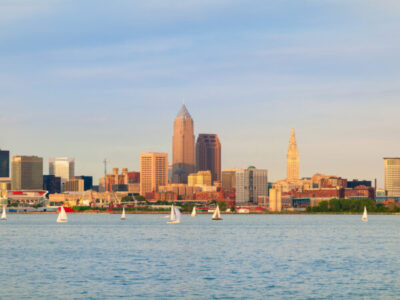
Featured image: Buffalo, New York skyline at golden hour over Niagara Square. (Photo Credit: iStock)