

By Vivian La, IPR
This story is made possible through a partnership between Interlochen Public Radio and Grist, a nonprofit environmental media organization.
No one wants to drive in an ice storm.
But one year ago — during the devastating northern Michigan ice storm that knocked down trees, snapped utility poles, and took out power for thousands — Wanda Whiting had to get her husband to a hospital. He was having a heart episode and calling an ambulance to their rural home in Lewiston would take too long. She had no choice but to brave the roads.
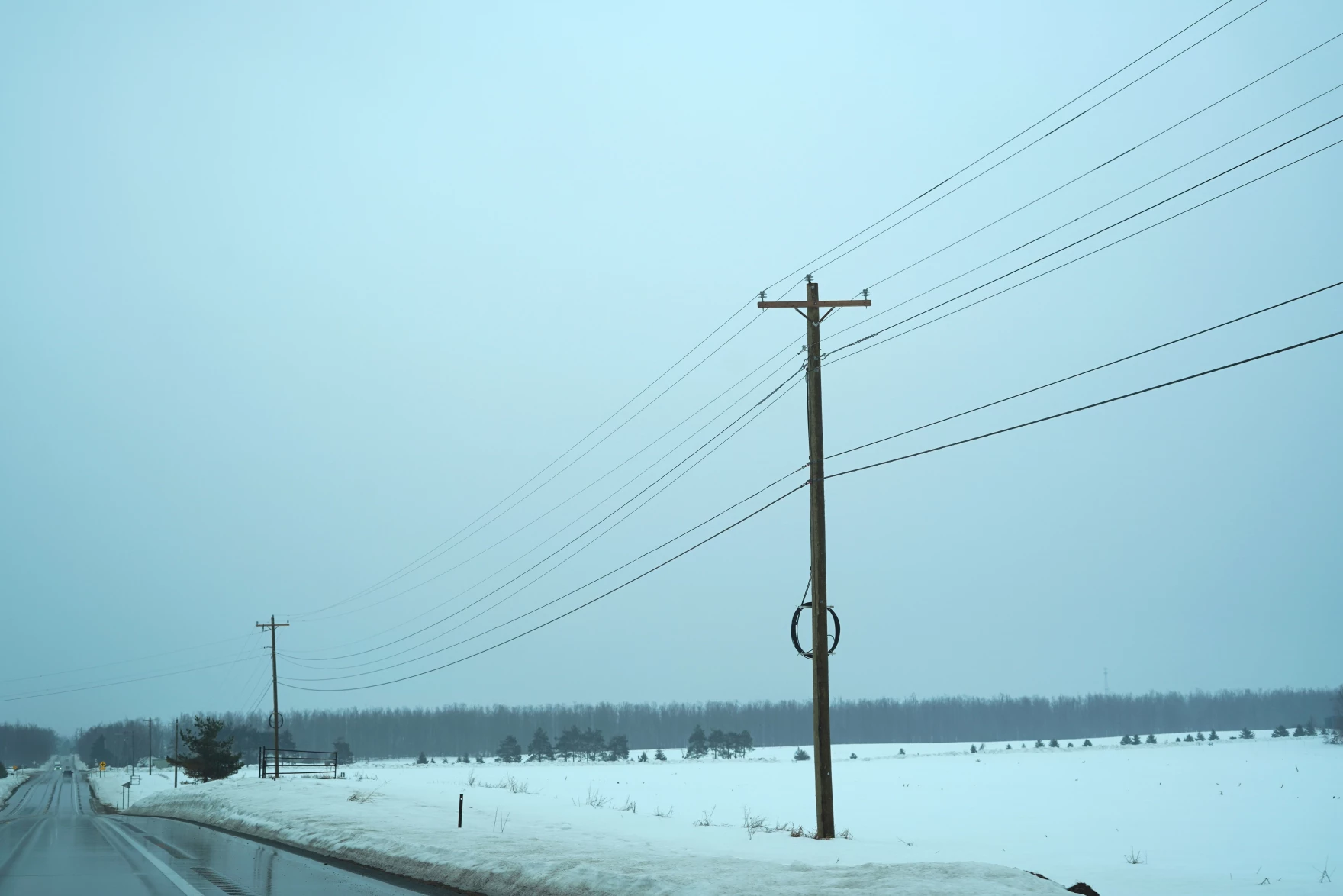
While driving the route almost exactly a year later, Whiting recalled the mess of dropped power lines and broken poles “like matchsticks” that littered the highway shoulder along the 20-mile stretch to Gaylord
“These were all down. Everything was down. These poles are all broken, snapped,” she said. Whiting remembered getting lost on dark roads with dead streetlights. She was trying to meet an ambulance at a halfway point. Arriving at the rendezvous parking lot, she had to drive across thick wires that had fallen on the roadway.
Her husband made it to the hospital. And eventually, in the weeks that followed, the power lines and poles went back up.
But Whiting can’t help but wonder how those wires will fare whenever she sees a forecast for snow and ice. And if there’s an alternative solution.
“And if it meant going underground, then by God, go underground,” she said.
After the storm
Burying power lines often comes up as a potential solution for preventing outages and minimizing the costs of storm recovery. And for good reason — underground wires are proven to increase reliability, according to researchers, electric utilities and regulators.
Now, as recovery from the ice storm continues a year later, some residents are calling for a more reliable grid that can withstand worsening extreme weather.
But burying lines is expensive, and utilities say those costs often outweigh potential benefits.
Last year, the storm knocked out power for some 200,000 people. Recovery cost utilities hundreds of millions of dollars, leading to increased electric bills for ratepayers across the region, as emergency federal aid hit delays.
The state’s largest electric co-op, Great Lakes Energy Cooperative, saw more than 66,000 power outages last year from the storm, and recovery costs totaled more than $150 million. In response to the storm, the co-op implemented a policy in December that requires any new lines to be installed underground, in an effort to increase resiliency.
“I think there’s reliability benefits for our membership, because it’s going to help prevent outages over the long term,” said Shari Culver, chief operating officer for Great Lakes Energy.
IPR reached out to the other hard-hit electric cooperative — Presque Isle Electric & Gas Co-Op — for comment about burying lines, but they declined due to ongoing discussions with federal agencies about pending storm relief funds.
Consumers Energy, another large electric provider in the region, says they hear from customers “consistently” about burying more lines. Last week, the Michigan Public Service Commission approved a $276.6 million rate hike for Consumers Energy — the largest increase in decades — to improve reliability for customers, which includes undergrounding some lines. Regulators said a typical residential customer using 500 kilowatt-hours a month will see an increase of $6.46, or 6.1%, in their monthly bill.
“There’s no better way to improve the resilience of the grid than just to get the lines out of the way of all the trees and ice and wind. Now, it comes at a cost,” said Greg Salisbury, Consumers Energy’s senior vice president of electric distribution. The company estimates it’s about $400,000 per mile to bury a line.
This year, Consumers Energy plans to bury more than 10 miles of lines around the state. That’s a small number, compared to the nearly 100,000 miles in the utility’s system, of which about 15% is already underground.
“Our viewpoint is that each circuit needs to be treated with the right interventions to get the best outcomes for the best cost for those customers,” Salisbury said.
To bury or not to bury
Burying power lines is relatively easier and cheaper with new construction, as crews install other utilities like water or gas. It’s in relocating the existing overhead lines where expenses for construction, labor and materials can add up quickly.
Burying electric lines isn’t a one-size-fits-all approach, either. Smaller utilities like Traverse City Light & Power (TCLP) are dealing with a different environment than rural co-ops, for example. In the city, there are more sidewalks, buildings, streets and other wires.
“There’s just not a lot of room to place that equipment in town without getting easements and such,” said Tony Chartrand, director of electric engineering and operations for TCLP, which has more than 170 miles of electric lines over 16 square miles in the city.
But, Chartrand said, for the municipal electric utility, there are still situations where burying makes more sense than stringing wires from poles. About half of TCLP’s lines are already buried, most running through conduit pipes, which protect wires from the elements or from accidental damage from other utility work.
TCLP tries to be proactive with burying power lines in hard-to-reach areas, like in people’s backyards, Chartrand said. In some cases, burying a residential line is cheaper than the costs of repairing aboveground wires after a tree falls on it.
Still, buried lines present their own challenges if there’s an outage. Unlike the clear visual cue of a branch hanging from overhead wires, problems underground require more equipment to find and fix.
“There’s times where, even if it is in conduit, we can’t just pull the wire out. We actually have to dig it up. And of course, that’s a whole ordeal and takes a lot of time,” Chartrand said.
There’s a lot of attention on grid reliability right now, he said.
“Part of that solution is undergrounding lines. But it’s not necessarily undergrounding everything. It’s trying to balance that cost with the benefit that we’re trying to do,” Chartrand said.
Ice storms and climate change
That balance could get harder to find as extreme weather worsens with climate change. Research suggests that northern Michigan could see more ice storms in the future, as a warming world shifts the range for freezing rain further north.
“Places where it used to be cold, below freezing all the time, it’s not always below freezing anymore,” said Richard B. Rood, a professor emeritus at the University of Michigan who studies how ice and freezing rain are changing.
It often takes big storms, like last year’s, for governments, utilities and people to spend money on planning for a warming world. And Rood sees that as a problem.
“You can’t think of what we’re experiencing as, ‘this is how it used to be, and this is where it will be.’ You are right in the middle of the change here,” Rood said.
Some policy experts say we won’t see more buried lines without significantly bringing down the costs to utilities. Eric Paul Dennis, research associate of infrastructure policy at the Citizens Research Council, said that could involve improving how we coordinate infrastructure projects so you only “dig once.”
“No one thinks that the best option is to operate outdated unreliable infrastructure and just fix it when it goes down,” he said. “But there are trade-offs. Investments must be recovered in rates. No option will be one hundred percent reliable.”
Still, only considering costs to utilities leaves out how much society benefits from having reliable electric service — roads are safer, food doesn’t spoil, people contribute to the economy.
“This is not because the utilities or people who run them don’t care, this is just the system we have,” Dennis said.