

Tom Talbot is a self-taught archeologist who discovered his passion when he was 11-years old. “Had a friend whose father worked in soil conservation and he was out in the agricultural fields of the area on a daily basis and he would collect arrowheads and flint knives and stuff and bring them home,” said Talbot. “And I just thought that was fascinating.”
What young Tom found while exploring the fields around him in Southwest Michigan were pieces of rock, just little chips and flakes. “I went back and found some heat fractured rock on a little sandy hill next to this marsh and started walking around and I picked up like 2 arrow points and a couple of flint knives, some broken pieces. And you know, that was thrilling to be able to actually go out and find a village site on my own.”
Talbot didn’t know it at the time, but he had stumbled upon a large ancient camp site occupied by Clovis people some 13,000 years ago. They were called Clovis people for the distinctive arrowheads they made out of rock. Not just any rock, but something called Chert. Chert is a sedimentary rock that was key to the existence of people who lived on this land during the Pleistocene era. The rock they worked with has two basic properties which make it useful for manufacturing stone tools: It breaks with a smooth fracture to form very sharp edges, and it’s very durable, perfect for making sharp tools and spear-points for hunting.
It was Talbot who approached the Archeology Department at the University of Michigan about this discovery in St. Joseph County. For the past four years, Archeology professors from the university have been overseeing this dig site in Southwest Michigan called the Belson Site, named after the family that now owns the farmland. “So we know the site was visited at least twice by Clovis groups,” says Brendan Nash, a Doctoral Student of Archeology at the University of Michigan. “May have been as many as four or five. That’s a primary question we’re trying to answer out here.”
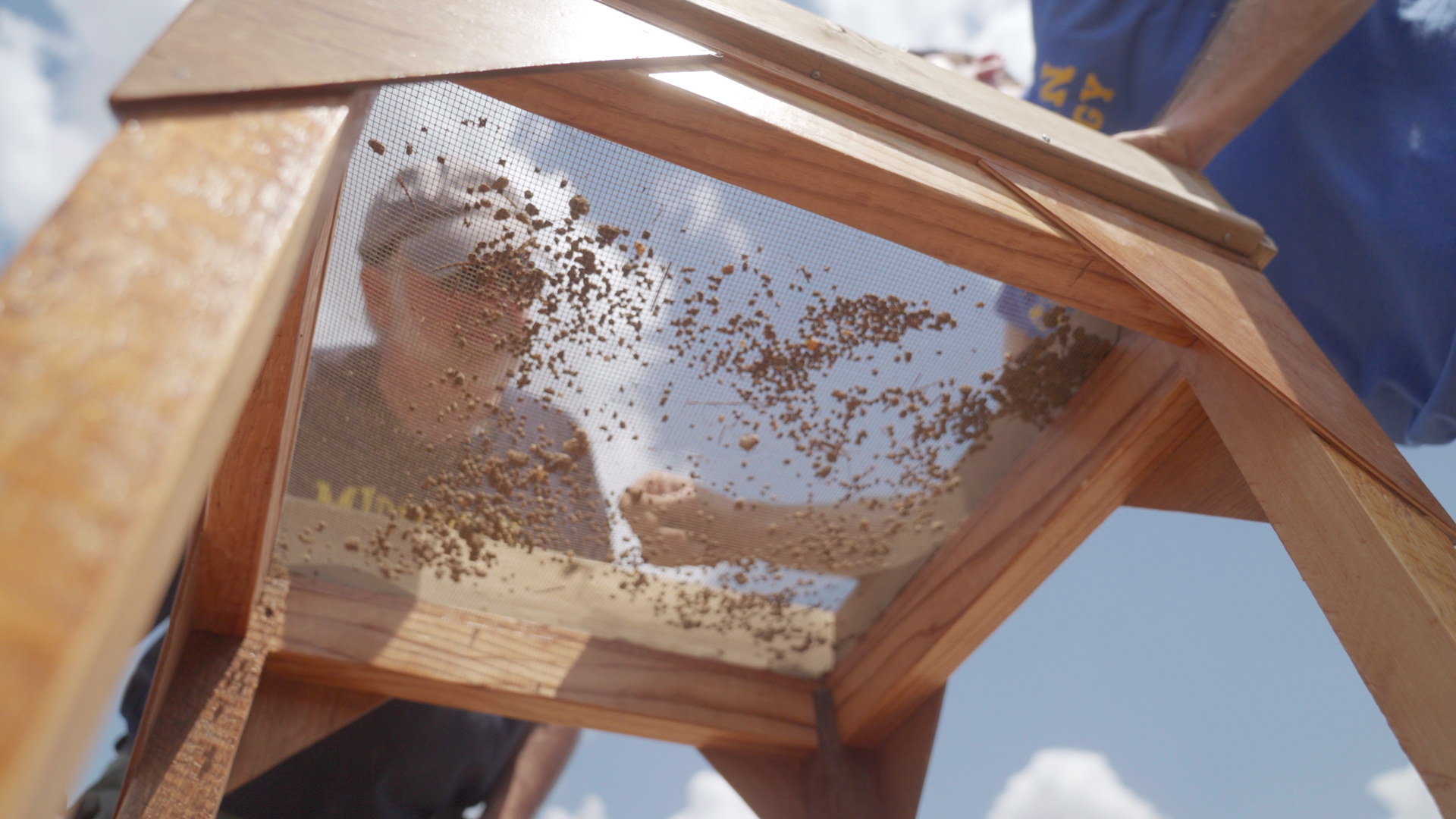
The work at the site is tedious, digging, scraping and then sifting under the hot sun. “So what we’re looking for are the tiniest little flakes,” says Nash as he sifts through a pile of dirt carefully removed from the site. Those tiny flakes are evidence that the Clovis hunters were making their spear points on this spot.
The Clovis Culture has been studied in the southwest and southeastern United States for many years, but this is the first time evidence has been unearthed showing that Clovis People occupied parts of Michigan.
Everything gathered at the Belson Site is closely examined and cataloged at the Research Museum Center at the University of Michigan. “So after we are in the field and we collect all of our data, they end up in bags with site name, dates, the unit, the elevation and essentially all the context from where it came from,” says Nash. “Tom determines what kind of stone it is. I determine a technologic category to put it in.”
The end result is a 3-D map of the Belson Site. “Each blue dot is a flake, each green dot is a C 14 sample to send off for radiocarbon. And our red dots are our formal tools,” says Nash as he points to the 3-D map. “And we see a strong cluster that we believe is a dugout heating feature. Maybe the first hearth, Clovis hearth to ever be found. And we modeled this completely in three dimensions.”
Talbot says he’s in his element working alongside professors in the lab, despite his lack of a formal education. However, it’s out in the field, working under the hot sun at the Belson Site that stirs up memories of how his life’s work began as a curious kid exploring his own neighborhood. “I do remember standing on a sand hill looking over a marsh, and thinking that someday I would make a significant contribution to archeological history and that happened.”