
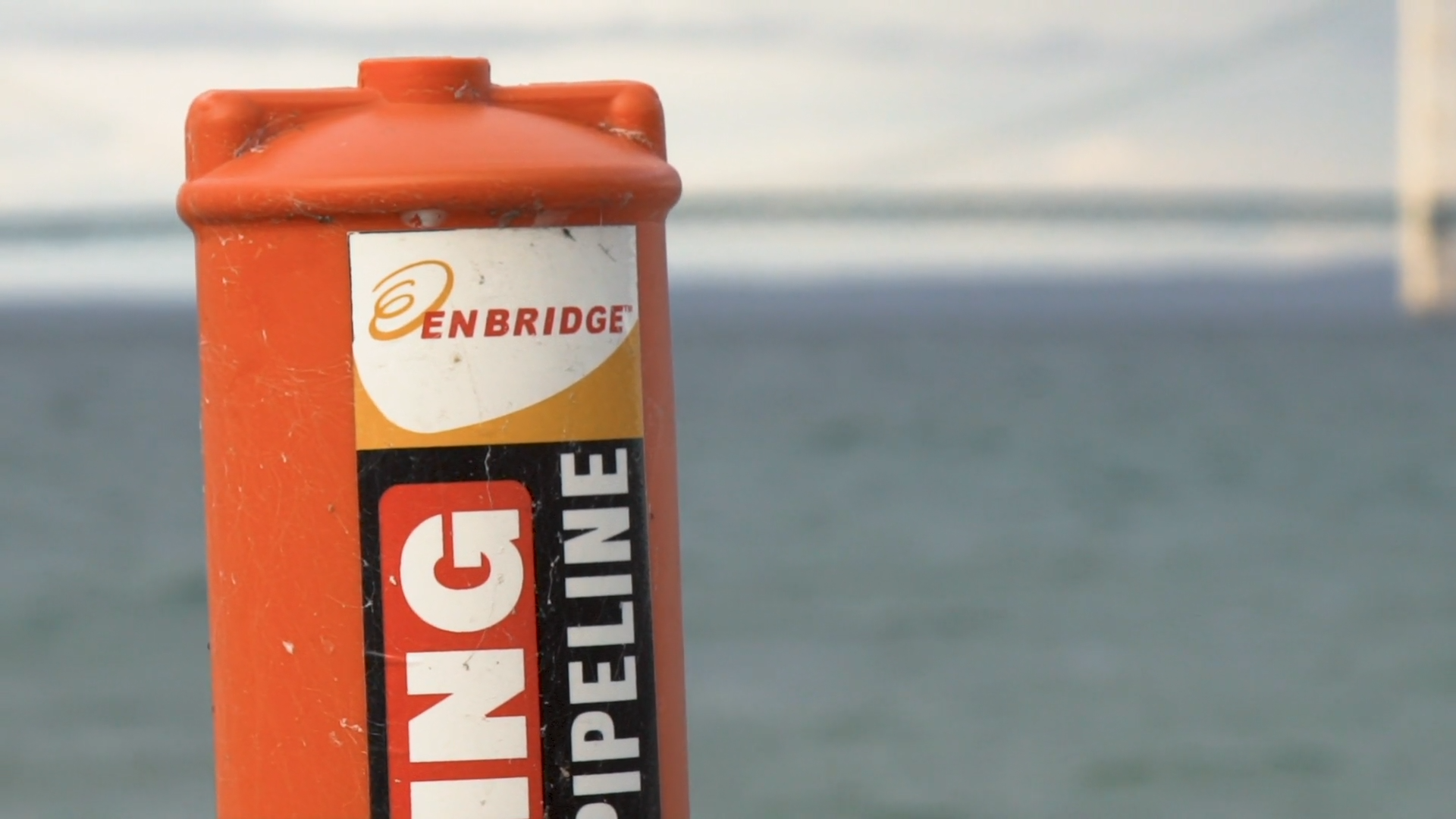

For over a decade, Enbridge Energy’s Line 5 has been the center of a political and environmental battle in Michigan. The legal conflict included state officials, federal agencies, tribal nations, environmental groups and the Canadian energy company fighting over what the future of the aging pipeline should look like.
But, in recent weeks, that debate has only become more complicated.
Michigan Department of Environment, Great Lakes and Energy (EGLE) issued a key environmental permit for a proposed tunnel on July 15, appearing to move the project closer to construction.
Two weeks later, the construction timeline moved farther away after the Michigan Supreme Court ruled that the Commission did not adequately consider the tunnel’s environmental consequences when giving the permit. The court sent the case back to the commission for further review.
The decision added another layer to a dispute that already involved state and federal courts, multiple government agencies and competing arguments about Michigan’s energy needs, the Great Lakes and Tribal treaty rights.
“We’re still in a state of limbo,” Mike Shriberg, Director of University of the Michigan Water Center and professor said. “The decisions in the last few weeks, rather than clarify, have probably muddied the waters more and extended the lifetime of the conversation and the decisions about the future of Line 5.”
And on August 12, the U.S. Army Corps of Engineers issued a long-desired permit for Enbridge for the construction of the tunnel. The next steps are securing the remaining permits and approvals needed for construction.
A long history
In 1953, Line 5 was built running 645 miles from Superior, Wisconsin, through Lake Michigan and Sarnia, Ontario. Initially, the pipeline’s lifespan was supposed to be around 50 years. Its 50th birthday was 23 years ago.
Most of the pipe is 30-inches, with the exception of the position beneath the straits of Mackinac. There, the pipe splits into two 20-inch lines that sit on the lakebed for about 4.5 miles.
That section has become the main bearer of controversy, with the central focus being a possible rupture that could release oil into the Great Lakes.
Safety concerns heightened after a 6-foot rupture in another Enbridge line, near Marshall, Michigan in July 2010. The break released over 1 million gallons of heavy Canadian crude oil into Talmadge Creek and the Kalamazoo River.
In 2018, due to human error, a ship’s anchor hit line 5 causing minor dents, but no oil was spilled.
The proposed Great Lakes Tunnel Project would run beneath the lakebed. Enbridge says the pipeline would sit about 100 feet below the lakebed, protecting it from ship anchors.
But the tunnel has yet to be built.
Why the debate is still ongoing
The newly proposed tunnel is only one piece of the larger Line 5 dispute.
In 2019, Michigan Attorney General Dana Nessel sued Enbridge in hopes of shutting down the existing pipelines in the Mackinac straits. She argued that Enbridge did not have a valid agreement to operate the pipeline under the straits, mainly that Line 5 was violating Michigan environmental laws.
This year, the U.S. Supreme Court ruled that Nessel’s lawsuit belongs in state court after Enbridge attempted to move it to federal court.
Separately, a federal judge ruled in December that Michigan could not enforce its 2020 order to shut down Line 5 — saying the federal pipeline safety laws overruled the state’s order. Since then, Michigan has appealed the decision.
The result is a series of overlapping cases moving through different courts.
“I think it’s mostly because the legal system that we have is set up to make it easier to delay than to move forward,” Shriberg said. “It’s pretty easy in our legal system to draw things out, to appeal, to stop things from happening.”
That’s why Line 5’s problems are difficult to summarize in a single legal storyline.
“It’s a complicated array of things going on that’s very hard to explain in a straightforward manner,” Shriberg said.
Enbridge’s case for keeping the pipeline
Through the last decade of controversy, Enbridge has maintained that Line 5 is an important part of the region’s energy infrastructure.
Ryan Duffy, an Enbridge spokesperson, said the pipeline carries light crude oil and natural gas liquids, with about 80% of the products being light crude oil and 20% natural gas liquids.
The company says Line 5 transports as much as 540,000 barrels of product each day, a figure also cited by the Michigan Public Service Commission. The company estimates that Line 5 supplies 65% of propane demand in Michigan’s Upper Peninsula and 55% of the state’s overall propane needs.
“A lot of people still heat their homes with propane in the U.P.,” Duffy said.
Line 5 is “at or near capacity,” Duffy said, and that the only other pipeline moving product toward Sarnia is Line 78 which is also at or near capacity.
“There is really no viable alternative to transporting the product that Line 5 carries,” Duffy said.
Enbridge’s proposed solution to safety concerns is the tunnel.
According to Duffy, the tunnel was determined to be the best solution for protecting Line 5 in the Straits. He said the project would eliminate the possibility of oil or other products escaping into the Straits.
Enbridge also points to the pipeline’s operating history.
The company says the straits crossing has never leaked during more than 65 years of operation and is subject to continuous monitoring and maintenance.
Yet, Line 5 has experienced spills elsewhere along its route. In 2017, a National Wildlife Federation analysis identified 29 known spills, busts and equipment failures along the pipeline since 1968. Between those spills, more than 1 million gallons of oil and natural gas have been released.
Concerns beyond safety
“The tunnel is really the common-sense solution going forward because it both protects the environment and makes sure that the product that people need continues to be delivered safely and reliably and affordably,” Duffy said.
For Bay Mills Indian Community President Whitney Gravelle, located in the Upper Peninsula, Line 5 is not a question of safety or energy supply.
“For my Tribal nation specifically, Line 5 is a threat to our way of life, to our Tribal treaty rights, to our cultural resources,” Gravelle said.
Line 5 crosses territory included in the 1836 Treaty of Washington, where Tribal nations yielded millions of acres of property to the United States while retaining certain rights, including what the treaty describes as the “usual privileges of occupancy.”
Gravelle said those rights depend on the health of the natural resources around them.
“You can’t have a treaty right to fish without clean water for fish to spawn,” she said. “And you can’t have a treaty right to hunt if you’re cutting down forests and filling wetlands.”
Protecting the Great Lakes is inseparable from protecting the Tribe’s culture for Bay Mills.
“We cannot be Ojibwe, Anishnabe, without the Great Lakes,” Gravelle said. “Our entire being, our culture, our language is interwoven into the Great Lakes.”
She says the Tribe opposes the tunnel because it believes moving Line 5 underground would extend the pipeline’s operation rather than eliminate the threat.
“We’re only focused on these four miles in the Straits without looking at the 645 miles that Line 5 traverses and asking ourselves, 100 years from now, do we still want Line 5 in the state of Michigan?” Gravelle said. “Because that’s what the tunnel would do. It would cement Line 5’s existence for the rest of time.”
Others have raised similar concerns.
Jeffrey Insko, an English Professor at Oakland University who writes a newsletter on Line 5, said the tunnel could lock in fossil fuel transportation for decades.
“What the tunnel really means is locking in fossil fuel transport for another 100 years,” Insko said.
For the tunnel, he said he is also concerned about whether the project would adequately protect the Great Lakes from environmental harm during construction.
“We need to be thinking about ways and investing in ways to reduce fossil fuel consumption rather than investing in prolonging the lives of fossil fuel consumption,” Insko said.
How needed is the pipeline?
At the heart of the disagreement is a key question: does Michigan need Line 5?
“The one thing that people haven’t looked into or covered enough is: What’s the need for Line 5?” said Shriberg of the University of Michigan. “There’s extremely good information out there that shows that Line 5 is not needed for use in the U.S.”
Enbridge says it does. Opponents say alternatives exist.
Gravelle said Enbridge should decommission Line 5 and instead use alternatives like using Line 78, which runs through southern Michigan from Indiana to Sarnia. She argues Michigan could continue getting energy supplies without Line 5.
“This ultimately is about Enbridge’s profits. It’s not about energy infrastructure,” Gravelle said.
Over the years, the state should have used the time to reduce its reliance on fossil fuels, she said.
“What could we have done in those 10 years to actually reduce our reliance on those issues?” Gravelle said.
Enbridge disputes any claims that there could be other ways to supply what the line holds, saying there are no viable alternatives capable of replacing everything Line 5 currently carries.
What’s next
The immediate future of the Great Lakes Tunnel is uncertain.
The Michigan Supreme Court’s July 31 decision requires the Michigan Public Service Commission to revisit its analysis of Enbridge’s tunnel proposal — which include the environmental impacts that the court said were not adequately considered.
“The Great Lakes Tunnel is on sort of an indefinite hold right now,” Shriberg said. “There’s not going to be any dirt moving in the near future.”
Duffy said the decision is disappointing and delays a project the company has spent years planning and permitting.
“We view that as disappointing because that is going to be an additional delay,” Duffy said.
The U.S. Army Corps of Engineers has also issued a federal permit for the tunnel project, adding another approval to the project’s permitting process.
At the same time, the legal battle over whether the existing Line 5 pipelines can continue operating in the Straits remains separate from the tunnel permitting process.
“They’re on separate tracks,” Shriberg said.
The goal remains clear for Enbridge: keep Line 5 in operations and move the straits crossing into an underground tunnel.
After more than seven decades, the pipeline remains in operation. And after years of lawsuits, reviews and political battles, the question of what happens to Line 5 is still unsettled.
“I would not expect any ‘final decisions’ on a Great Lakes Tunnel until 2027 at the earliest,” Shriberg said.
For now, the pipeline continues to carry petroleum through the straits while the courts and regulators decide whether its future lies beneath the water, inside a tunnel, or somewhere else entirely.