

This is an edited excerpt from “Where the Green Light Shines: A Fifty-Year Odyssey from the Boundary Waters to the Far North.” Bridging the arctic expeditions of the nineteenth century and today’s recreational paddling tradition, “Where the Green Light Shines” chronicles the tradition of canoe exploration, told through the journeys of a true master of the craft, Bob O’Hara. Below is an excerpt of the book that focuses on the Boundary Waters Canoe Area Wilderness.
Bob O’Hara resumed his vernal boreal migration at an unprecedented rate, doing long trips down the Canadian Elk River into the Thelon in 1987, then the next year taking a three-river route that went from the Nowleye to the Kunwak and out into the Kazan, on which Steve Kirkhorn came back for another go. Also on this trip were newcomers B. J. Kohlstedt and her husband, John. O’Hara had befriended the Kohlstedts at Wolf Ridge, a youth camp they were all involved with in the hills north of Lake Superior.
In early 1989, O’Hara eagerly planned a first descent of a far northern river. Joining this trip at the last minute was Gayle Knutson, who the year before had retraced several hundred miles of a legendary canoe journey. Knutson was from the lakeland of northwestern Minnesota and had grown up on the water. She began venturing north as a means of self-validation after a disastrous hiking trip. A few years earlier, in 1986, when still in her twenties, Knutson was backpacking with friends in Grand Teton National Park and contracted giardia — the dreaded “beaver fever,” named for the parasite’s carrier — from drinking river water.
With stomach cramps, vomiting and dysentery, she needed a doctor. Her friends, though, wanted to continue their hike and told Knutson she was on her own. In her weakened state, and reeling from their refusal to help, Knutson was unsure whether she could hoof it out, though finally one friend agreed to walk with her to the nearest road where she could hitch a ride. Knutson was worried about hitch-hiking alone. She was a petite young woman in unknown Wyoming.
“What if it’s two guys with an axe and some rope?” she quipped. Eventually a park ranger came by and gave her a ride into town.
Knutson was unsettled by the whole experience. She feared something was fundamentally wrong with her that had caused her friends to discard her. She lived in Minneapolis and one day read in the newspaper about an organization called Wilderness Inquiry that brings both able-bodied and disabled clients into the wilderness.
Knutson volunteered for a trip to see if she repelled a different set of travelers as she had in the Tetons. She joined Wilderness Inquiry on a winter dogsledding trip in the Boundary Waters and was relieved to find that she was a likeable soul. Even better, afterward, the trip’s leader, Robin Monahan, asked Knutson if she’d be interested in retracing eight hundred miles of Ernest Oberholtzer and Billy Magee’s 1912 canoe trip.
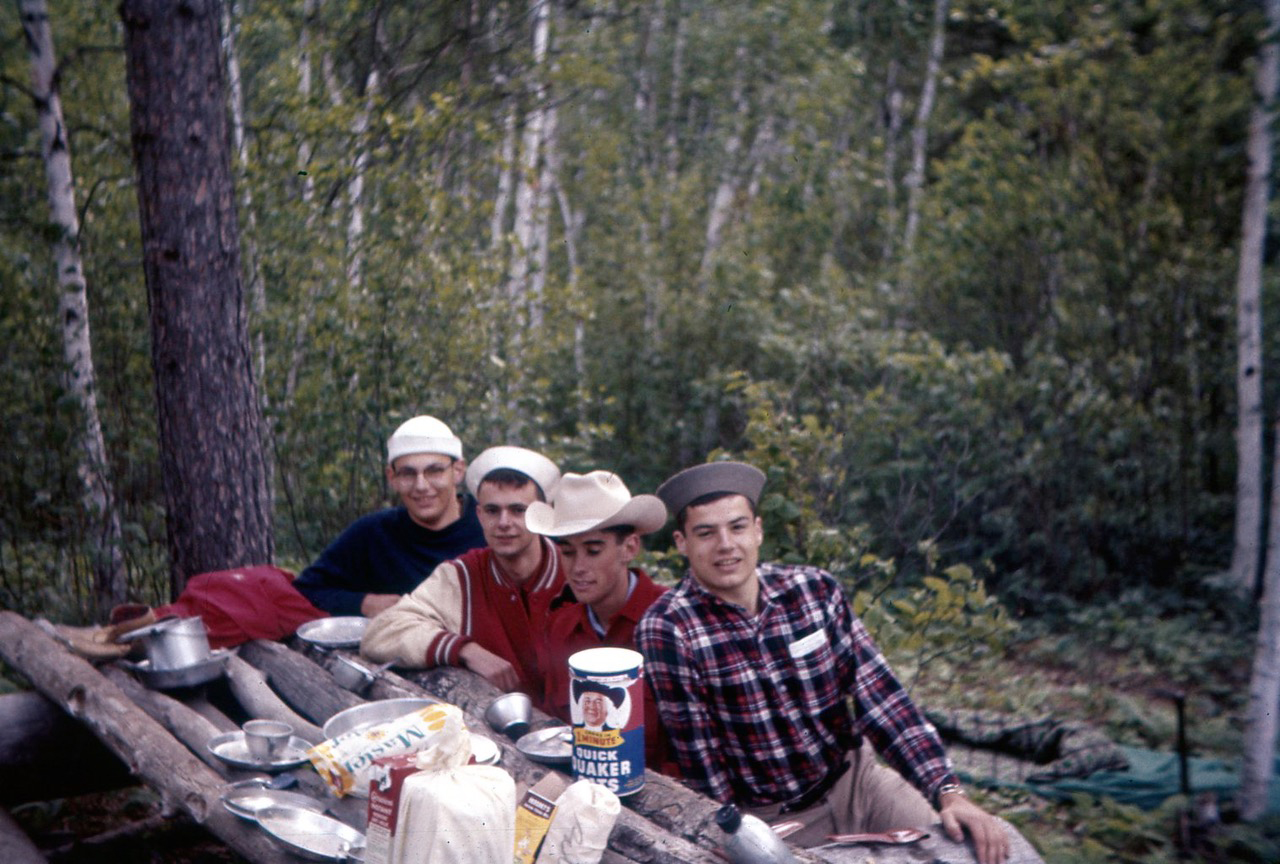
Monahan had already sussed her out, asking: if Knutson joined his crew and something awful happened to her, what would she like done with her body? Her response of “leave me for the animals” was evidently good, because he offered her a slot that she eagerly accepted. Monahan’s parents had been friends with Oberholtzer (called “Ober” by his friends and admirers), and Monahan had fond boyhood memories of the conservation hero.
Ernest Oberholtzer was better remembered for his work later in life, when he saved the Boundary Waters from the lumber baron Edward Backus, who nearly succeeded in installing a network of dams along the old Voyageur’s Highway. The dams, which would have speckled the northern border from its west side more than seventy miles east to Lake Saganaga, would have raised water levels on dozens of lakes, giving Backus an easier means of transporting his felled pines to mill. Ober’s work led to Congress passing the Shipstead–Nolan Act in 1930, a massively important victory in the early American environmental movement.
Existence cleaves along such fine lines. Actual events unfold only the way that they do, yet the “what ifs” of narrowly avoided alternate histories are impossible to suppress. Had Ober not derailed Backus’s dams, what is today’s Boundary Waters Canoe Area Wilderness would instead be a patchy mosaic of wildish lake clusters surrounded by mansion-rimmed lakes buzzing with motorboats, the old Voyageur’s Highway a flooded corridor with convenient road access.
The Boundary Waters would resemble lakes most anywhere else — accessible, inhabited and not conducive as water trails for long canoe trips. Sigurd Olson’s canoe country muses would have retreated after the caribou to the higher north, leaving him to write about duck hunting and fishing, topics his own journals reveal to have increasingly bored him.
The egg from which the whole canoe country culture fledged would have cracked in the nest; the bird that Gore-Tex pilgrims follow north in their canoe-hatted cars never would have flown, left in a pile of crushed shells and dead modern potential with the state’s prairies, savannas and big woods. Minnesota would be a different place entirely, its anchor to its natural history set adrift. Bob O’Hara would be a high school teacher somewhere with several children, a gunslinger of a wife who knew how to shut down her husband when he got churlish, and to whom a canoe was just a little boat.
To read more about the tradition of recreational canoe trips in this region, be sure to check out “Where the Green Light Shines” from your local library or Bookshop.org.