

About three days before a crane chick hatches, Cindy Gitter begins listening for sounds inside its egg. At the International Crane Foundation outside Baraboo, Wisconsin, I followed Gitter into an incubation workroom, where an old wooden incubator stood across from a glass-fronted hatcher. Gitter, the foundation’s assistant curator of birds, explained how she checks eggs for movement and listens for the first calls.
“Once they start talking at you, then they move over into this hatcher room,” she said.
At a worktable, Gitter showed me crane eggshells she had emptied and was preparing to fill with plaster. She calls them “dummy eggs.” When I asked whether they taught adult cranes how to incubate, she corrected me.
“It’s not to train them,” she said. Cranes already know how to incubate their eggs.
Many of the foundation’s resident cranes lay infertile eggs. Gitter replaces them with plaster copies before they rot and begin to smell, which can prompt the adults to abandon their nests. Siberian cranes make particularly good foster parents. When a Siberian pair isn’t breeding, Gitter can place plaster eggs beneath them and later exchange the substitutes for viable whooping crane eggs.
The International Crane Foundation began in 1973 on a horse farm the Sauey family rented to founders George Archibald and Ron Sauey for a dollar a year. The organization moved to its current property in 1983. Today, its nearly 300-acre headquarters houses more than 100 cranes. Visitors can see all 15 of the world’s crane species at the Crane Discovery Center, while Crane City and other facilities beyond the public exhibits accommodate breeding and veterinary care.
Gitter receives eggs from Crane City and from wild whooping crane nests in Central Wisconsin. Her team disinfects the eggs before placing them in incubators. Gitter also discussed breeding black-necked cranes, transferring demoiselle and wattled crane eggs, and earlier work raising brolga and hooded cranes.
By the early 1940s, the total whooping crane population had fallen to approximately 21 birds. The foundation now consults genetic records when choosing breeding pairs, although genetically compatible cranes don’t always accept one another as mates. Some young cranes stay in human care because their genes are underrepresented in the breeding population. Others are raised for release into Wisconsin’s eastern migratory population, where they can join wild whooping cranes and learn migration routes from experienced adults.
Learning to live in the wild
Photographs at the foundation show caretakers wearing full-length white costumes with screened hoods and black gloves. In one image, a caretaker reaches toward a rust-colored chick with a crane-head puppet. Caretakers feed and exercise the chicks in these disguises to reduce the chance that the birds will later seek humans as mates.
During an earlier reintroduction experiment in Idaho, sandhill cranes fostered whooping crane chicks. The young birds learned to migrate but later sought sandhills as mates and failed to reproduce with whooping cranes. Today, crane parents raise some chicks, while costumed caretakers raise others. Before the next breeding season, caretakers separate young cranes from their parents because the adults may become aggressive and drive them away. In the wild, juveniles can leave their parents’ territory. At the foundation, their enclosures prevent them from escaping.
“There’s a mixture of innate and learned behavior in cranes,” Gitter explained. Young birds develop the instinct to migrate, but experienced cranes teach them the route. When conservationists began reintroducing whooping cranes to Wisconsin in 2001, the juveniles had no experienced adults to guide them south. Pilots led them to Florida behind ultralight aircraft, a journey documented in a photograph displayed at the foundation. The aircraft-guided program ended in 2016.
“Now we are releasing cranes near other cranes that are teaching them those migration routes,” said Hillary Thompson, the foundation’s director of whooping crane reintroductions. “It’s a lot more natural for them to migrate in that way, following other cranes.”
Thompson’s team releases young cranes once they can fly well enough to survive in the wild, giving them time to join experienced birds before autumn migration. “It’s finding that sweet spot,” she said. Many whooping cranes in the eastern migratory population now spend winter in southern Indiana and northern Alabama, although others migrate farther south. Earlier generations followed ultralight aircraft to Florida.
By Oct. 1, 2026, the eastern migratory population numbered an estimated 65 Whooping Cranes, including 18 hatched in the wild. Conservation biologists and volunteers track individual birds during migration using leg bands and electronic transmitters.
Eastern sandhill cranes continued breeding in the state even as their numbers declined elsewhere, helping researchers identify suitable places to reintroduce whooping cranes. Each autumn, thousands of sandhills feed in harvested fields around Baraboo before settling onto sandbars along the Wisconsin River to roost. Whooping cranes sometimes join them. During one fall viewing, International Crane Foundation observers counted at least 4,000 sandhills and identified three endangered whooping cranes among them. Two had grown up with costumed caretakers before their release at Horicon National Wildlife Refuge.
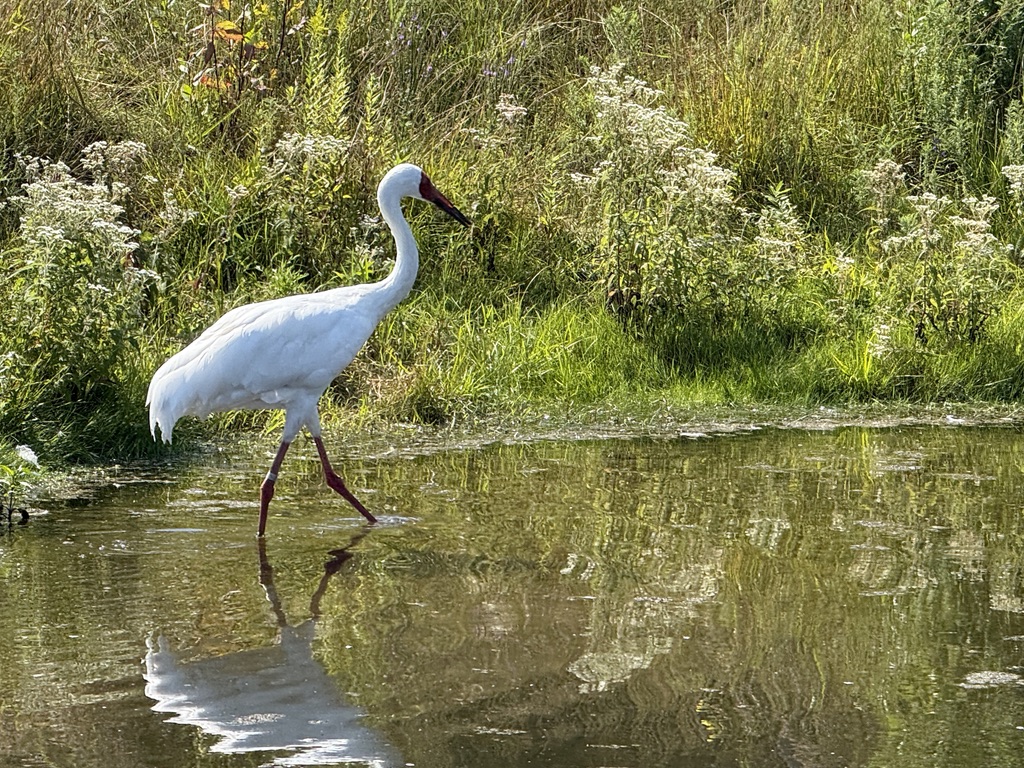
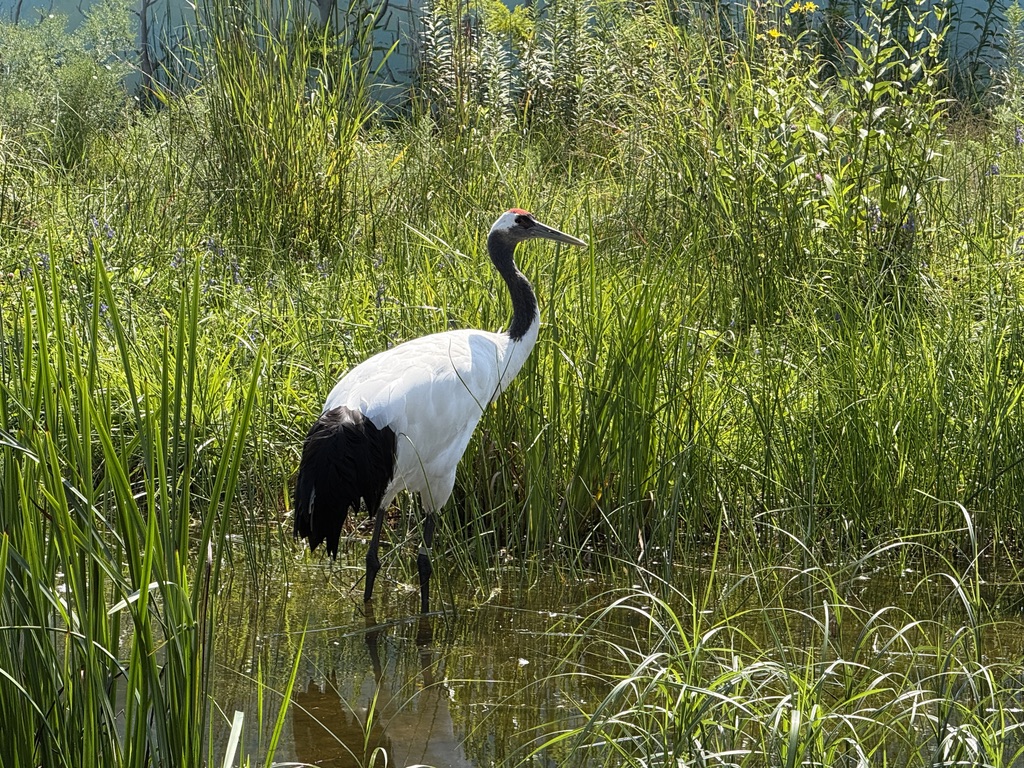
During my visit, a crane walked along the edge of a pond bordered by grasses and wildflowers. Thompson explained that whooping cranes prefer walking through shallow water, although they can swim. The previous week, she watched cranes pull crayfish from the wetland. Nearby, tall vegetation nearly concealed another five-foot bird after it walked into the plants and then stood still.
“It’s fun that they’re big like us,” Thompson said.
Their size lets her observe individual birds and recognize their behavior. Bonded pairs also communicate through coordinated calls.
“When they unison call, it’s a duet,” she explained. “It’s kind of a call and response.”
A guide described the long tracheas of North American cranes, which coil inside their bodies “like a French horn” and help produce their distinctive voices.
Every two or three years, whooping cranes molt, replacing all their flight feathers at once and temporarily losing the ability to fly. Thompson explained that molting cranes often stay in wetlands, where they can hear predators approaching through the water.
Medicine in the marsh
Veterinary technician Sara Kalani described carrying medical supplies through Wisconsin marshes to examine wild whooping crane chicks before they can fly. Her team catches the young birds long enough to draw blood, examine them and attach identification bands before releasing them.
Kalani previously worked in veterinary clinics: “Instead of bringing the patient to the medicine, you take the medicine to the patient,” she said.
An adult whooping crane stands about five feet tall, with a wingspan of more than seven feet. Handling one requires care. A crane’s bill can injure a handler, and the bird can jump high enough to bring its powerful feet close to a person’s face. I asked Kalani what holding one feels like.
“You are holding a bird under your arm that is so large,” she said. “They are heavy but light at the same time, if that makes sense.”
She also described the cranes’ distinctive “fish-water smell.”
Every resident crane receives at least one hands-on examination and blood draw each year. Kalani also visits Crane City with a medical kit for routine treatments. Caretakers sometimes hide medication in smelt to help the birds swallow it.
Kalani showed me the foundation’s ultra-low-temperature freezer, where researchers preserve serum and DNA samples from cranes that have lived at the facility.
“We bank serum and DNA samples from birds we’ve had, so it’s a very special archive,” Kalani said.
Some specimens date back decades. One member of the veterinary team called the collection “liquid gold.”
Nearby cryogenic storage tanks preserve semen from cranes that once lived at the foundation. Researchers can analyze samples from birds that have since died and compare them with material collected from later generations.
The foundation connects its ultra-low-temperature freezer and incubators to a backup generator. During power outages, the generator keeps decades of biological samples frozen and maintains the temperatures developing crane embryos need to survive.
Thompson calls the three major threats to wild whooping cranes “the three P’s”: predation, power-line collisions and poaching. Her reintroduction team has also begun testing young cranes’ responses to predators using a stuffed raccoon. She called it “a little cute stuffed animal raccoon that they’re very afraid of.” The experiment was in its early stages when we spoke.
Experienced Parents Raise More Chicks
Thompson and her colleagues studied 194 wild-hatched whooping crane chicks in Wisconsin’s eastern migratory population between 2006 and 2023. Thirty-six survived long enough to fly. Researchers recorded most losses during the first three weeks after hatching, although they could not determine what happened to every chick.
“We’ve learned that adults that have more experience raising chicks on their own are better at keeping chicks alive,” Thompson said.
The researchers estimated that pairs nesting together for the first time had approximately a 13% chance of fledging a chick. For pairs with 12 years of nesting experience together, that probability rose to about 35%. The study found a relationship between nesting experience and chick survival, although the researchers could not establish whether experience alone caused the difference.
Whooping cranes can live into their 20s or 30s in the wild, Thompson explained, and some of the first cranes released during Wisconsin’s reintroduction are still living there. Several cranes in human care have reached their 40s.
“We’re also focusing on adult survival,” Thompson said. “So that we can keep adults alive long enough to get that experience.”
Wisconsin’s eastern migratory population had one of its strongest breeding seasons in two decades, with four wild-hatched whooping crane chicks learning to fly in 2026. One of them, W7-26, hatched on May 31 at Necedah National Wildlife Refuge in Juneau County.
Its 22-year-old father, identified as 2-04, first nested in 2010 and had already raised two chicks to flight with a previous mate. In August, he and his current mate, W14-19, successfully fledged their first chick together.
Plan a Visit: Great Midwest Crane Fest
The International Crane Foundation and Aldo Leopold Foundation will hold the Great Midwest Crane Fest on November 14–15, 2026, in Baraboo, Wisconsin. Visitors can attend presentations and guided walks at both foundations, including tours of the Crane Discovery Center and historic Leopold Shack. Additional ticketed excursions visit Wisconsin River viewing sites where thousands of sandhill cranes gather before migration. River-viewing tours require advance reservations and may sell out.
Festival information and registration: https://greatmidwestcranefest.org/