
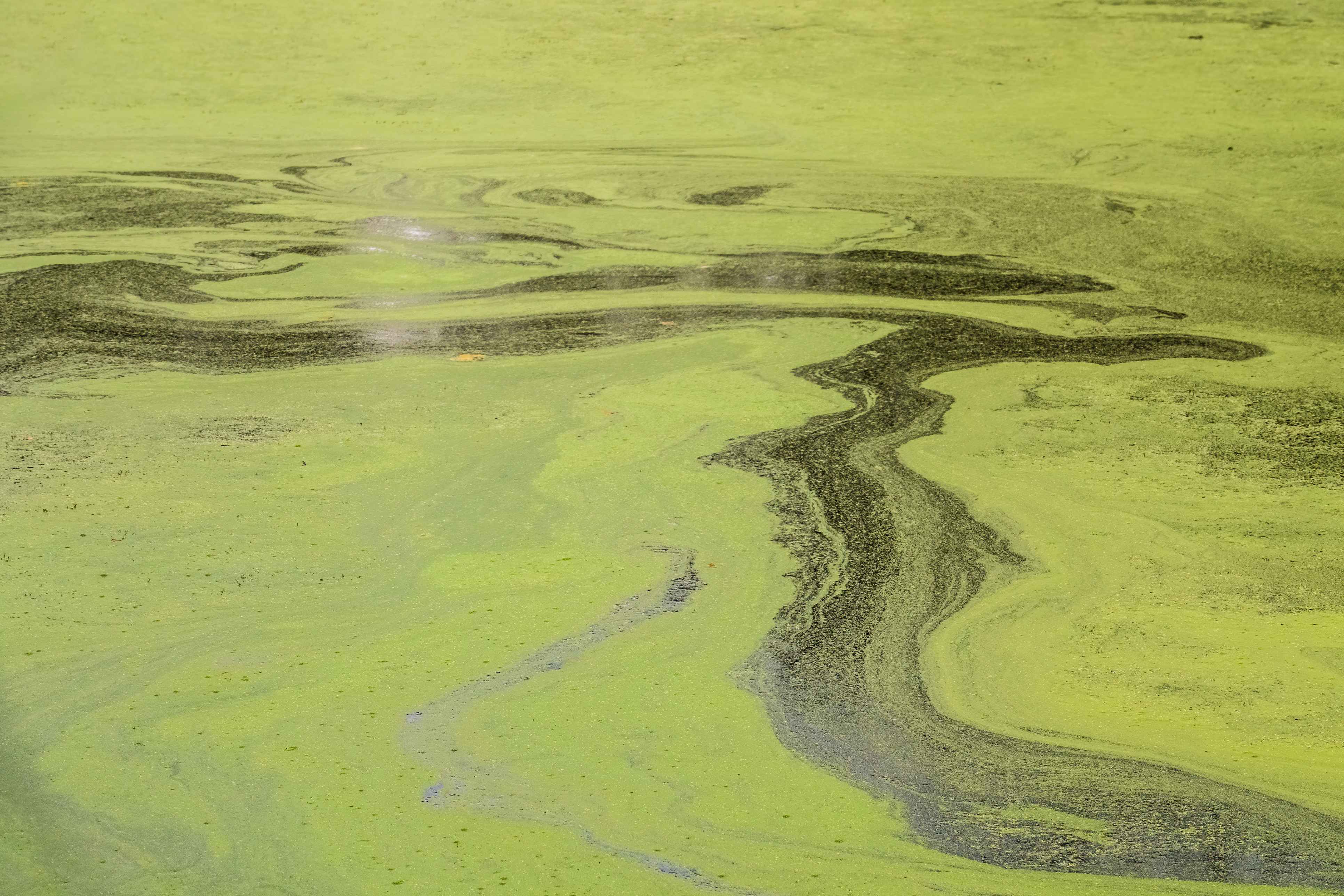
Every spring, as the Great Lakes region warms, scientists begin watching for the return of harmful algal blooms. While the average passerby doesn’t notice the blooms until the bright green layer covers the shoreline, scientists can begin predicting the blooms weeks or even months before they become visible.
Harmful algal blooms are the rapid growths of toxin-producing bacteria that infiltrates drinking water, threatens wildlife and can cause health risks to people and pets.
The forecasts for the blooms are important not only for beachgoers, but also for fishers and businesses that depend on the Great Lakes.
While harmful algal blooms occur throughout the Great Lakes, the National Oceanic and Atmospheric Administration (NOAA) currently issues seasonal forecasts only for western Lake Erie, which has the right combination of nutrients, weather and decades of scientific data to forecast, compared to the other lakes.
The reason for forecasting the lake is simple: Lake Erie’s algal blooms can threaten drinking water, recreation and the local economy.
Predicting blooms
While NOAA’s short-term forecasts help track blooms as they develop over the span of a few days, the seasonal outlook looks months ahead. These predict how severe the bloom is likely to be based primarily on phosphorus levels in the Maumee River.
The Maumee River flows from Indiana east through Ohio, ending in Toledo, where it drops off into the western side of Lake Erie. Agriculture along the waterway dumps phosphorus from fertilizers into the river, which carries nutrients to the lake.
When too much phosphorus enters Lake Erie, it acts like fertilizer, feeding algae and driving the harmful blooms that spread across the lake each summer.
“The main factor that impacts how bad a bloom is going to be is the amount of nutrients,” said Gregory Dick, director of the Cooperative Institute for Great Lakes Research at the University of Michigan.
Dick said that NOAA’s seasonal outlook intentionally focuses on bloom size rather than location in the basin because winds, lake currents and weather determine how algae moves and accumulates throughout the summer.
“The seasonal forecast is essentially predicting how bad the bloom is going to be that year,” Dick said. “It’s not making specific predictions about when or where the bloom is going to be.”
Every year in late June, NOAA releases its seasonal forecast for harmful algal blooms in western Lake Erie. This year, the agency predicted a moderate bloom, and by mid-July, the first visible signs of cyanobacteria had begun appearing in parts of the lake’s western side.
Harmful effects, compounded by a changing climate
Algae on its own is not an issue. It is a naturally occurring part of the Great Lakes ecosystem, and is the base of the food chain “that feeds the small shrimp-like organisms that then feed the fish and everything else in the lake,” said Thomas Bridgeman, an ecology professor and director of the Lake Erie Center at the University of Toledo.
The problems begin when extra nutrients, like phosphorus or nitrogen, wade into the lake, prompting an overgrowth of algae and the rapid reproduction of certain kinds of bacteria. One of the more harmful kinds is the cyanobacteria, which behave like algae but produce chemicals dangerous to people and animals.
“They’re particularly worrisome because they can produce really potent toxins,” Bridgeman said. “If they get into drinking water supplies, or if they wash up on beaches and people or dogs are exposed, they can be made very sick or even die.”
These dangers became clear in 2014 when toxins from a harmful algal bloom contaminated the city of Toledo’s drinking water. It left about 50,000 residents without safe tap water.
Although nutrients drive most of the bloom’s growth, weather determines how much phosphorus actually reaches the lake from agricultural fields.
“In years when we have much more rainfall, there’s much more runoff, and that washes more phosphorus into the lakes and causes bigger blooms,” Dick said.
Rick Stumpf, an oceanographer who leads NOAA’s harmful algal bloom forecasting efforts at the National Centers for Coastal Ocean Science noted that not all rainy springs look the same.
“A wet spring could be because it just keeps raining, or because there’s a week of intensive rain,” Stumpf said. “The worst blooms have occurred when there have been floods in the Maumee River Basin.”
Rising lake temperatures from global warming are adding more uncertainty to predicting blooms.
According to October data from the Great Lakes Environmental Research Lab operated by the NOAA, all five of the lakes were around 4 to 5.5 degrees Fahrenheit warmer last fall than their long-term average for the last three decades.
Warming temperatures are also extending bloom seasons across the Great Lakes, Dick said.
Calm weather on the lakes favors blooms because of how mobile the algae can become.
“Winds matter because these blooms do better in calm water,” Stumpf said. “If it’s calm, they float up to the surface and block the light, keeping the competition down.”
Stumpf also said the organisms dominating Lake Erie’s blooms have preferences in their environment.
“Lake Erie cyanobacteria like warm water, but they particularly like water with a lot of nutrients, especially phosphorus,” he said.
Using technology
Once a bloom begins developing, forecasting shifts from seasonal forecast to daily predictions.
“Satellite data is a key piece because we can determine how much bloom there is over the whole lake every clear day,” Stumpf said. “That’s way more data than you can possibly get from field sampling and way cheaper.”
The satellite imagery distinguishes harmful cyanobacteria from beneficial algae that forms the base of the food chain, something that is hard to notice for the everyday beachgoer.
There are two types of algae forecasts the NOAA publishes — one that predicts long-term, months in advance, and another that is short-term, days in advance.
NOAA’s short-term Lake Erie forecasts, which began operationally in 2016, combine satellite observations with predictions of wind and water currents
By combining satellite observations with weather forecasts, predictions can be precise.
“Satellite images can tell us where the bloom is now,” Dick said. “The forecast can tell us where the bloom is expected to go in the next few days based on forecasts of wind and water currents.”
The short-term forecasts can help know what to expect in the lake over three or four days, Stumpf said.
Still, forecasting has its limitations.
“You can always make a prediction,” said Dan Obenour, a professor in the Department of Civil Construction and Environmental Engineering at North Carolina State University focusing on water quality dynamics. “As you go further and further out in the future, the uncertainty increases. At some point, the forecast becomes useless.”
Researchers have found that conditions through late June provide the most reliable window for forecasting Lake Erie’s harmful algal blooms.
By June, scientists can estimate how large the harmful algal bloom is likely to grow over the course of the summer, Obenour said. This is largely determined by the amount of phosphorus that washed into Lake Erie during the spring.
“For Lake Erie, we can only forecast a few months ahead,” Stumpf said. “We can’t forecast further than our confidence in the weather models.”
Outside of Lake Erie, forecasting continues to be more difficult.
“We don’t understand all the factors yet,” Stumpf said. “The Lake Superior blooms are very event-related, so there’s no way we could forecast those far in advance.”
Forecasts in the future
Even though there are still restrictions to predicting algae blooms, researchers are looking to improve forecasting.
Dick said one of the biggest challenges is predicting toxicity rather than the bloom size.
NOAA is expanding what it hopes to predict going forward.
“We’re now trying to forecast not just how big the bloom will be, but how scummy it will become and how long it will last,” Stumpf said.
He said forecasting has also helped them learn important lessons for preventing blooms in the future.
“Our ability to forecast blooms means we have a good understanding of the factors that cause them,” he said. “Knowing that phosphorus in the spring is the key factor helps guide efforts to keep phosphorus off farm fields.”