

This article comes from Sarah Hermann, Assistant Professor, Department of Entomology & Program in Ecology at Penn State.
Some of the collaborative work from my lab has recently gained visibility, which is exciting but also requires careful explanation. After all, my job as a scientist doesn’t end with the research. I am committed to translating our findings into clear and understandable information for all. So, read on to learn about this exciting work.
Community Observation Becomes a Research Question
Sometimes research questions begin with a carefully developed hypothesis, a stack of scientific papers and months of planning.
And sometimes they begin with scientists listening to what the public is observing. This work began with numerous reports of folks saying, “Hey, why are there dead spotted lanternflies under my milkweed?”
A simple question, involving two really important organisms.
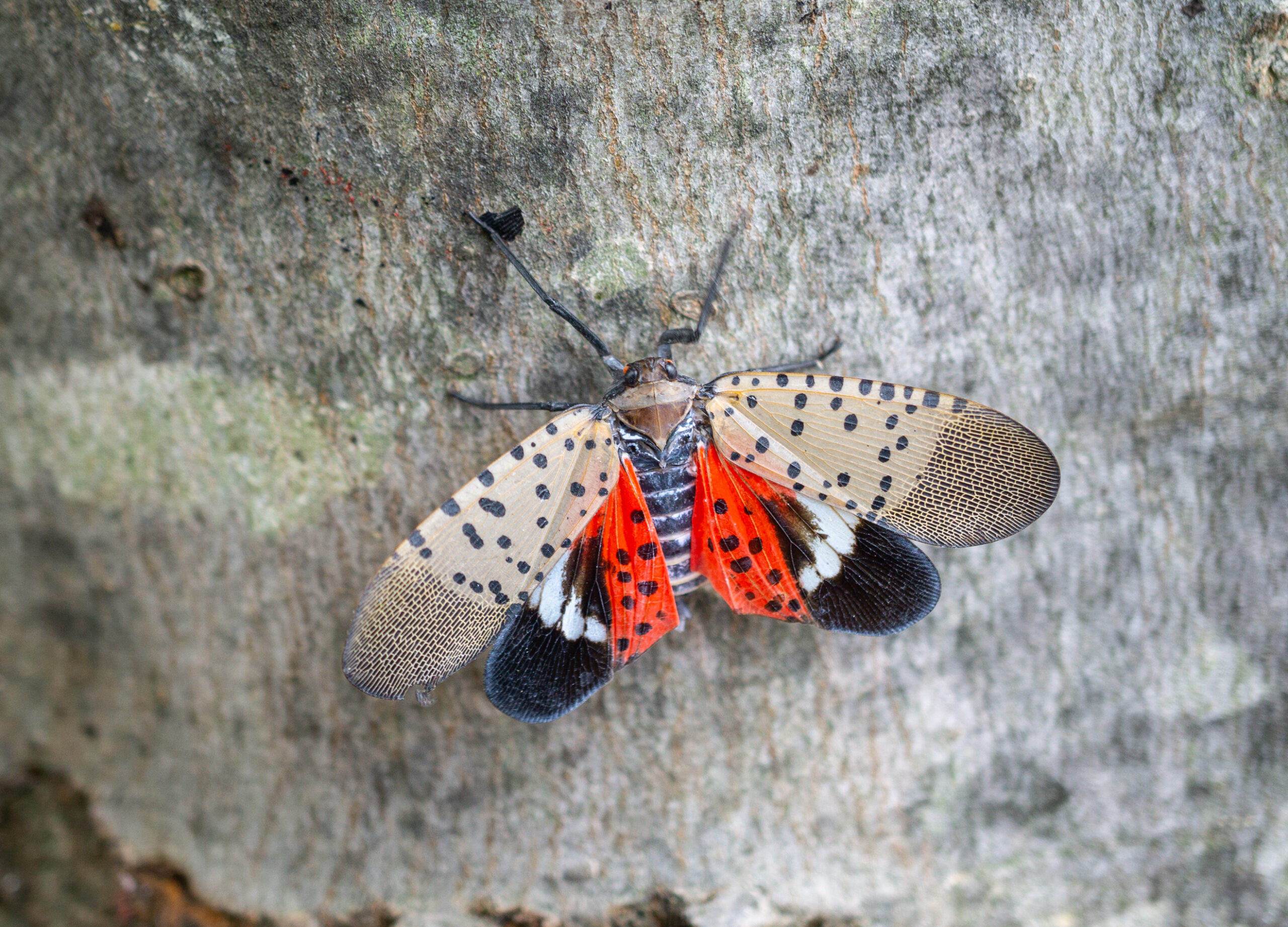
One main area of research in my lab includes monarch butterflies and milkweed conservation, particularly in urban and suburban landscapes where people intentionally plant milkweed to support monarch populations. At the same time, I was serving on the committee of a graduate student, Anne Johnson, studying predation of spotted lanternfly (Lycorma delicatula), the invasive planthopper that has become a familiar, albeit unwelcome, sight across much of the Eastern United States.
Independently, both of us began hearing something interesting from members of the public: people were finding dead spotted lanternflies around milkweed plants.
Once we realized we had both been hearing the same observation from different people, we had an obvious question:
Could milkweed actually kill spotted lanternflies?
Putting the backyard observation to the test
Milkweed plants in the genus Asclepias are certainly capable of defending themselves. They produce latex and a diverse array of defensive chemicals that make them a difficult, or downright dangerous food, for many herbivorous insects.
Monarch caterpillars are famously adapted to deal with some of those defenses, a fact that has been the basis of monarch and milkweed research for decades. Spotted lanternflies (SLF) are another story. Here, we had the unique opportunity to combine Anne’s SLF research with my lab’s work to address the questions and observations from the public.
To find out what was happening, we brought field-collected spotted lanternflies into controlled greenhouse experiments and offered them three milkweed species native to Pennsylvania: common milkweed (Asclepias syriaca), swamp milkweed (A. incarnata), and butterfly weed (A. tuberosa). We planned to put SLF into a cage with the milkweeds for one day, after which we can go back and see if SLF are alive or dead. In all honesty, we did not expect to see anything striking.
But, for this experiment, we also needed controls. A plant that SLF feeds on, that we do not expect to cause mortality. Here, we chose grape. Grape is a preferred host of spotted lanternfly, and is also one of the major cropping commodities that have been negatively affected by this invasive pest. So, in our experiment, some SLF were placed in a cage with a grape plant. Others received no plant at all, to determine if starvation could explain any mortality we saw in the experiment.
That last treatment was particularly important. If lanternflies simply refused to feed on milkweed and then died, we might mistakenly conclude that milkweed was toxic when the insects were actually starving. But, that’s not what we found!
Instead, we saw that lanternflies exposed to milkweed experienced substantially greater mortality than those given grape. We also demonstrated that short-term starvation resulted in relatively little mortality.
Across milkweed species and lanternfly life stages, mortality in our no-choice experiments ranged from roughly 10% to 90% within only 24 hours. On common milkweed, about 86% of third-instar lanternflies and 90% of adults were dead after 24 hours!
While starvation contributed to a small amount of SLF mortality, it was not able to explain the mortality we observed when SLF was with milkweeds.
In other words, something interesting was definitely happening.
But what if they have something better to eat?
Of course, locking a spotted lanternfly in an enclosure with nothing but milkweed isn’t particularly representative of what happens outside. So, while we can say that milkweeds are indeed toxic to SLF, we still don’t know how often this interaction occurs outside.
Essentially, the question now becomes, if a lanternfly has access to a delicious grapevine, why would it bother feeding on milkweed? We were able to next address this in our experiments by providing the SLF a choice in our caged, greenhouse setting.
When offered both grape and milkweed, the lanternflies generally preferred the grape. There was a significant preference for grape in 47 of our 72 observations. But they didn’t completely ignore milkweed. They still interacted with it, fed on it and we still observed mortality even when the grape plant was also available.
That finding became particularly important when we started thinking beyond the greenhouse.
So…what is toxic to them?
This is where the story gets particularly interesting.
If you know anything about monarchs and milkweed, you may immediately suspect cardenolides.
Cardenolides are potent defensive compounds produced by many milkweeds. Monarchs have evolved adaptations that allow them to tolerate these compounds and even sequester some of them in their bodies, contributing to their own chemical defense against predators.
So, cardenolides were obvious suspects for the spotted lanternfly deaths.
But our results aren’t giving us a nice, simple cardenolide story.
We observed mortality on all three milkweed species, despite substantial differences among those species in their defensive chemistry. And in chemical analyses conducted so far, we haven’t detected cardenolides in the lanternflies that fed on the plants.
That doesn’t mean we’ve ruled cardenolides out. An insect doesn’t necessarily need to accumulate a toxin in its body for that compound to harm it. We need more information at this stage to determine what is causing this effect.
But it does make us suspect that cardenolides alone may not explain what we’re seeing. Milkweeds contain a complicated cocktail of defensive chemistry, and identifying the mechanism responsible for the lanternfly mortality is now one of the really interesting pieces of this puzzle.
The lanternflies didn’t look very good, either
Interestingly, in these experiments, mortality wasn’t the only thing we noticed.
This “result” is observational rather than a formally quantified result, but, lanternflies that had been feeding on milkweed often behaved very differently from those in our control treatments.
They became sluggish and unsteady. Normally, spotted lanternflies are quite good at living up to the “lanternfly” part of their name when someone approaches, they’ll jump or move away. But milkweed-fed individuals often became much less responsive. As they approached death, some were almost completely unresponsive except for small movements or twitching. This is something we have also observed in the field.
Exactly what physiological process produces those symptoms is another question we don’t yet have an answer to.
And that’s part of the fun of doing research and having the opportunity to do this work.
Could we actually use milkweed to manage spotted lanternflies?
Finding that milkweed can kill a spotted lanternfly in a greenhouse is scientifically interesting.
Finding that milkweed can reduce spotted lanternfly populations in the real world would be something else entirely.
Thanks to funding from Northeast SARE, we’re now taking the next step: testing milkweed plantings in vineyards and other areas experiencing spotted lanternfly pressure. Those field experiments are currently underway. This work is in collaboration with Dr. Flor Acevedo, Associate Professor at Pennsylvania State University in entomology.
The idea of milkweed being used to mitigate SLF pressure is intriguing. Could native milkweeds planted within or around agricultural areas create opportunities for lanternflies to encounter and feed on a plant that harms them? Could milkweed eventually become one small piece of a more ecologically based integrated pest management strategy?
The truth is, we don’t know yet.
There is a big difference between mortality in a controlled greenhouse experiment and population suppression in a vineyard. Lanternflies would need to encounter milkweed, choose to feed on it, consume enough to experience an effect, and ultimately die often enough for that mortality to matter at the population level.
Those are exactly the questions we’re now trying to answer.
Should you plant milkweed to kill lanternflies?
Not yet.
Or, more accurately: yes, plant native milkweed! But plant it for the reasons we already know are important.
Native milkweeds provide critical resources for monarch butterflies and contribute habitat for other insects. What our research does not yet show is that planting milkweed in your yard will meaningfully reduce the spotted lanternfly population around your home. We have suggestive data from our experiments, anecdotal evidence from our field observations, and reports from the public.
What makes the possibility so exciting is that we’re not proposing to introduce another exotic organism or to plant something solely to control an invasive pest. These are native plants that we’re already working to restore for their conservation value.
If those same plants turn out to provide an additional ecosystem service — helping suppress an invasive agricultural pest — that would be a pretty remarkable bonus.
From backyard observation to experiment
One of my favorite things about this entire project is where it started.
The question came from the community.
People were paying attention to the insects and plants in their yards. They noticed something unusual. They told scientists what they were seeing. And because multiple people made similar observations, we were able to turn that observation into a testable scientific question.
The observation held up experimentally.
The explanation, however, turned out to be considerably less straightforward than we expected.
We thought we might find a simple story involving a well-known milkweed toxin. Instead, we’re left with a more interesting set of questions:
- What exactly is killing the lanternflies?
- How much do they need to consume?
- Why does the effect vary among milkweed species and lanternfly life stages?
- And, most importantly, can an effect we see in the greenhouse actually matter in the landscape?
That’s science doing what science does best: one good observation answers a question and gives us five new ones.
And in this case, it all started when someone looked under a milkweed plant and wondered why there were dead bugs on the ground.