
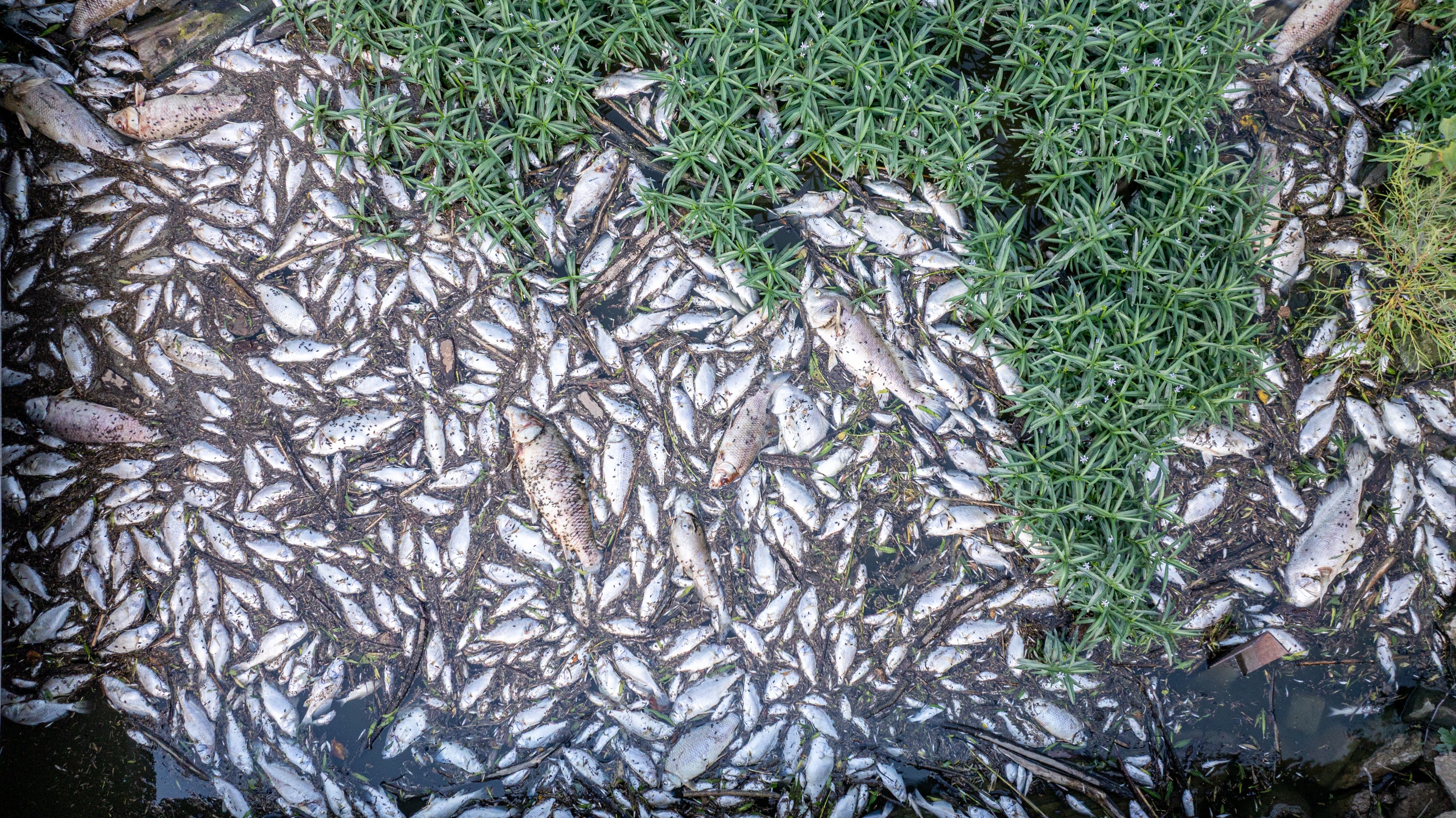
On July 3, a liquid fertilizer spill at a Henry County farm services operation in Holgate killed tens of thousands of fish and shut down the main drinking water supply source for the City of Napoleon.
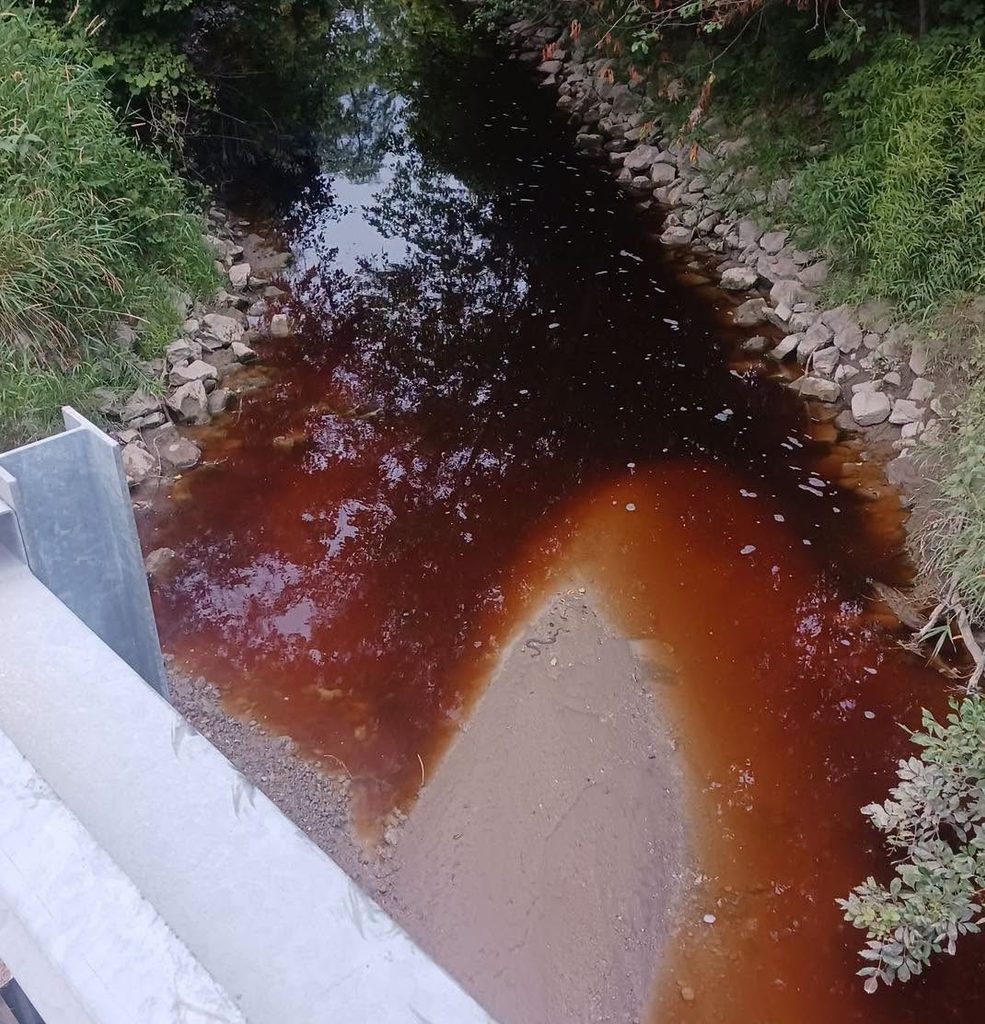
The site of the spill was a facility operated by Triway Nitrogen, LLC on property owned by Farmer’s Supply and Grain Company on a county road near Huston Creek. According to an Ohio Environmental Protection Agency (OEPA) report, the fertilizer solution entered a drainage ditch and storm sewers on the property before entering Huston Creek, which is a tributary of the Maumee River.
Originally the two companies brought in contractors to create earthen dams to help contain the spill, according to the Henry County Engineer’s Office. Huston Creek was the site of mitigation activity including the construction of three dams as well as vacuum trucks and other heavy equipment. However, a torrential downpour several days later caused creek water to breach all three dams, one of which was erected by the engineer’s office, releasing the fertilizer.
Despite the fact the spill was more than two months ago, no information has been released about the exact cause of the release or how many gallons of fertilizer were sent into Huston Creek and subsequently, the Maumee. In early July, Great Lakes Now reached out to OEPA, Ohio Department of Natural Resources (ODNR) and the Ohio Department of Agriculture (ODA,) though none could provide those details.
While initial estimates were that between 18,000 and 20,000 fish were killed, the ODNR later revised the estimate to 24,571 fish. A statement issued by the ODNR indicated fish ranged from 3-inch sunfish to 40-inch grass carp.
The fertilizer, called “UAN 28,” is made up of 28% urea ammonium nitrate. This fertilizer is known to provide fast-acting yet slow-releasing nitrogen for field crops. And while it’s great for farmers, it’s not so great for fish.
“Generally, what causes a fish kill is a drawdown of oxygen, for one reason or another the oxygen is removed,” said Jim Hood, associate professor in the Department of Ecology, Evolution and Organismal Biology at Ohio State University. “It causes a growth of bacteria and so biology has to happen in the background, at least when nutrients are involved, it’s not the direct result of the nutrients, the fertilizer, it’s the nutrients stimulating bacteria growth and the bacteria draw down the oxygen and boom, you’ve got dead fish.”
Hood explained that a toxic chemical spill is likely to kill on contact, with a fertilizer spill fish slowly suffocate due to lack of oxygen in the water. As a secondary impact, he said a lot of dead fish is not a good thing.
“It would certainly cause more oxygen depletion and also, losing the fish is going to wreak havoc on the food web,” he said. “As all that material decomposes it leads to growth of bacteria which is going to take more oxygen out of the water. It will extend the fish kill a little longer.”
Smaller fish or prey which are sensitive to low levels of dissolved oxygen will be temporarily missing from the food web which will affect fish higher on the web which rely on those smaller fish for food, Hood explained. However there is an upside for some wildlife.
“On the flip side, marine animals that wash up and die end up fueling food webs on beaches, with crayfish and insects and all the things that are dying in the marine system,” said Hood. “So it’s going to have a short-term choking effect, especially if it’s a large fish kill, though also it will be a food source to other organisms.”
Official details on spill scarce
Details about the incident from the ODNR are scarce. Great Lakes Now reached out to the ODNR fisheries office in Sandusky, though biologists declined to answer any questions about the fish kill or talk about fish kills in general.
Andy Chow, ODNR chief of communications, said that the incident is under investigation, and that the state retains the option to request restitution for wildlife lost. Other Great Lakes states, including Michigan and Wisconsin, can collect civil penalties for fish killed in streams through illegal dumping or accidental releases of harmful substances.
Triway Nitrogen and Farmer’s Supply declined to make any statements about the incident and declined to provide a press release they said had been prepared.
As for the Ohio Department of Agriculture (ODA) and the OEPA, both responded to emailed questions.
According to Jessi Starkey, communications specialist with the ODA, there were five tanks containing fertilizer on the property. Three tanks each had a 30,000 gallon capacity while the remaining two tanks had a capacity of 1.5 million gallons.
Generally accepted industry standards indicate approximately 38% of the UAN 28 liquid solution is water — though the exact percentage of urea, ammonium and nitrates are considered trade secrets by the manufacturer BASF. The multinational company, based in Germany, BASF is known as the largest chemical manufacturer according to sales.
When Great Lakes now spoke with Starkey on July 23, she indicated the actual physical cause of the release is still under investigation and declined to speculate further. The ODA’s role in an incident like this is to determine whether any fertilizer storage regulations were violated, and if so, the agency would pursue penalties outlined by Ohio law.
In a follow-up email, Starkey later Aug. 20, she indicated the facility was ordered to empty the tanks and not re-fill them until it was demonstrated that they are in compliance with Ohio law.
According to Anthony Chenault, public information officer with the OEPA, their role is to oversee and assist with cleanup during an emergency response and provide guidance to responsible parties as they work to address ongoing issues. The agency determined the leaking tank was about 1,200 feet from Huston Creek and about six miles from the Maumee River. According to the information provided, the cleanup is ongoing and there is no set date for completion.
Possible restitution
While Chow said the state retains the option of restitution, he did not say the state would pursue it. In other Ohio cases, polluters have been ordered to do so.
In a 2021 incident a Kenton man was charged in federal court for violating the Clean Water Act after dumping 7,000 gallons of an ammonia substance into the Scioto River and killing more than 43,000 fish. Subsequently, he was sentenced to 12 months of probation, fined $5,000 and the ODNR ordered the man to pay $22,508 to the Division of Wildlife.
In 2017, three northwest Ohio farm operators were fined more than $30,000 for an incident in which they spread manure onto fields before August rainstorms. Investigators believe the rain washed ammonia-laden manure into creeks, killing almost 67,000 fish. State agricultural regulations prohibit farmers from spreading manure on fields when conditions are likely to lead to increased runoff into streams.
Ohio Administrative Code assigns values to all types of wildlife, including fish, birds, mammals and mussels. The values are based on a combination of factors including recreation, aesthetic, education, economics and population dynamics — among other things.
A common occurrence in the region, though majority are “natural”
Wildlife agencies often receive reports of large numbers of dead fish in a concentrated area, although most often, they are naturally occurring.
“Natural fish kills happen all the time,” said Tim Cwalinski, a fisheries biologist with Michigan Department of Natural Resources’ Lake Huron management district. He cited decaying vegetation, drastic weather patterns and other natural changes that trigger dissolved oxygen levels in water.
“Pretty much right now I’ve seen less than a handful of unnatural fish kills in my career but I’m in Gaylord in Central Michigan and so we don’t have the industry and farming that you might see in Southern Michigan.”
According to Cwalinski, unnatural fish kills in his heavily wooded region come from dam failures which inundate streams with sediment, silt and anoxic (near zero oxygen) water, instead of contaminants like fertilizer and chemicals.
In Wisconsin, a leaking fertilizer tank at a dairy farm sent fertilizer into subsurface drainage tiles which drained into an unnamed tributary of the Sheboygan River on June 11, according the Wisconsin Department of Natural Resources (WDNR.) Staff were responding to the site of a reported fish kill when they discovered the leaking tank, according to a press release.
Last autumn, the WDNR investigated a five-mile fish kill on a stream in Taylor and Clark counties. At a large livestock farm in Central Wisconsin multiple spills have occurred including one of about 100,000 gallons of manure. A Trempealeau County farm spill was found to be the site of a fish kill on two streams after WDNR staff responded to an anonymous tip.
The WDNR declined to discuss incidents with Great Lakes Now.
In 2019, a Portage, Indiana steel plant on Lake Michigan released toxic ammonia and cyanide into a river leading to the lake. The release caused a fish kill and the closure of multiple beaches including beaches at Indiana Dunes National Park.
While Cwalinski said all such human-caused releases are bad, the more water in a stream or lake, the better.
“You don’t want it in either streams or impoundments, but you know, a lake has more volume and the solution to pollution is dilution,” he explained. “If there’s something in a stream that has a small discharge it will always be more vulnerable.”
According to Cwalinski, pure water is a precious commodity.
“We don’t want anything non-natural,” he said. “There are natural sources of things in streams like methane vents, like Fletcher Pond up here in Alpena County, that has natural methane vents. But that happens in some waters all the time but those systems can handle it, it was happening before humans were here. Any time that humans are involved with stuff, we’re the ones that screw it up.”
Great Lakes Now will update this story after final reports are released.